Aftermarket Parts
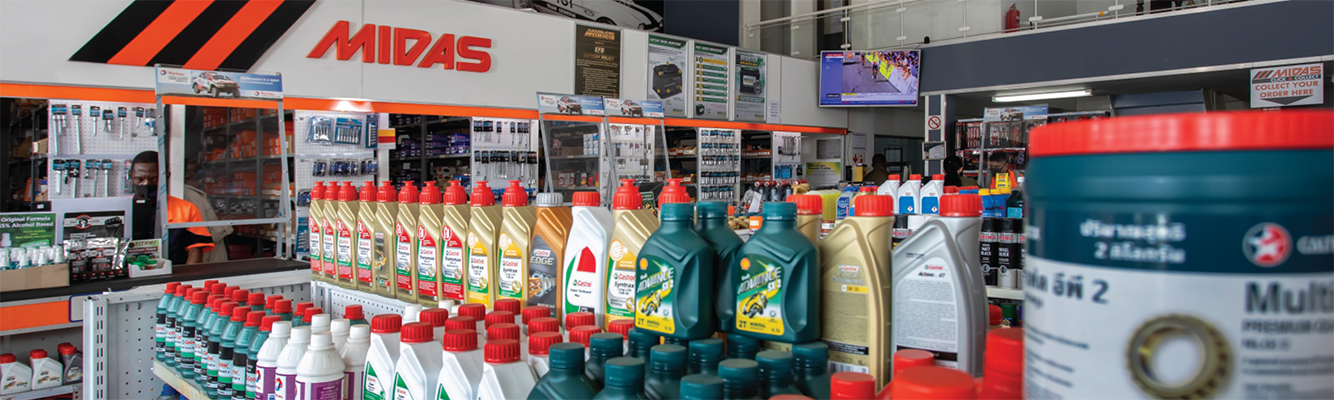
The Aftermarket Parts business segment is a distributor, wholesaler and retailer of accessories and parts for mainly out-of-warranty vehicles through its owned and franchised retail stores, and specialised franchise workshops supported by distribution centres in South Africa, Taiwan and China. The UK business (known as FAI) is a wholesaler selling parts to the UK and European markets.
The business's large national and growing footprint in Southern Africa and the UK enables us to leverage our buying power to distribute and sell competitively priced products to a continually growing and ageing car parc of out-of-warranty vehicles.
The international distribution centres in Taiwan and China allow for procurement at competitive prices for distribution to Southern Africa, the UK, Europe and other international territories.

Malcolm Perrie
CEO – Aftermarket Parts
2022 priorities
Continue to source new growth opportunities by:
- Supporting the recovery of the South African customer base and growing the South African business.
- Implementing strategic acquisitions to expand our geographical and retail footprints and increase profitability.
- Exploring opportunities to expand through wholesale operations in Africa.
- Strengthening the core business through supply chain optimisation, improved efficiency, volume buying and expanding the product range and brands.
- Investing in IT to drive digitisation and e-commerce expansion.
- Ongoing optimisation of our distribution footprint.
- Optimising inventories to increase parts availability.
- Developing international distribution capabilities.
- Investing in 'clean green' workshops to manage our environmental impact, supporting socio-economic improvement and deepening governance maturity.
- Ongoing investment in the training, job support and career development of our people.
Geography
Distribution centres located in South Africa, Taiwan, China and the UK.
Stores and distribution points
Franchises and agencies

Owned retail

Regional distribution

International distribution

Canopy manufacturing

Accessories and parts value chain

Component
manufacturers

Agents

Manufacturer
distributors

Wholesaler

Reseller


Fitment

Consumers
- South Africa has a car parc of over 12 million vehicles with ICE engines and an average passenger car parc of 10 years or older, the UK has a car parc of 35 million ICE vehicles and Australia has a car parc of 20 million vehicles with ICE engines.
- Mainly supply vehicle parts outside OEM warranty terms.
- Focus on supplying wear parts with a product offering of over 135 000 individual stocking units to the reseller and fitter market.
- Market demand driven by mobility of the car parc.
- Replacement cycles are either time dependent (such as oils and rubber components) or mechanical failure (usage dependent).
Aggregate product




Functions
| 1 |
Source components from
multiple sources to:
|
| 2 | Create
|
| 3 | Manage and control suppliers and quality |
Wholesale distribution



Functions
| 1 |
Source product to store and
distribute to resellers
|
| 2 | Sell to end consumer
|
| 3 | Manage and control channel to market |
Retail



Functions
| 1 | Source products from ‘own’ wholesale and selected drop shipment suppliers |
| 2 | Sell to end consumer
|
| 3 | Manage and control the last mile |
| 1 | OES: Aftermarket parts distributed by the OEM. |
| 2 | DIY: Do it yourself. |
Growth opportunities
Expanding our procurement and wholesale capabilities in South East Asia, the UK, Eastern Europe and other markets provides a significant opportunity for the business to increase utilisation and improve profitability of the distribution centres. Increased participation in this segment will also include backward integration to reduce reliance on intermediaries in the wholesale supply chain. Our controlling interest in Arco in Taiwan and the distribution centre in China support this strategy and enables us to leverage our buying power to procure parts at competitive prices.
The acquisition of FAI, one of the UK's leading distributors of premium aftermarket automotive components, positions us as a supplier to the wholesale distributor market, enables access to export markets in Eastern Europe, and complements our strategy to integrate the distribution footprint that we have built in Asia, with a retail footprint in countries where we are currently operating in.

We continue to explore opportunities to grow our market leading footprint in South Africa, expanding our wholesale and retail distribution channels in the UK, and expansion into the aggregator market while growing our e-commerce capabilities. We will continue to optimise our supply chain and distribution capabilities and explore expansion into other international markets.
2022 performance
We continued to strengthen our core business by streamlining our distribution capability, shortening our routes to market and leveraging our ability to procure large volumes at lower prices to cater for broader market penetration.
Inflation, high unemployment and rising fuel and electricity costs have seen consumer disposable income levels continue to decrease, driving a corresponding rise in demand for more affordable products and increased supplier and competitor activities. Social unrest, the flooding in KwaZulu-Natal, global supply chain difficulties and inventory shortages together with reduced demand from affected customers, negatively impacted the South African business. This was offset by increased sales and improved efficiencies.
Increased foreign activity and a new logistics supplier saw the Asian business performing well over FY2022, and FAI (included as of 1 October 2021) has shown promising performance over the past nine months.
We remain focused on developing a consolidated end‑to‑end supply chain with a broad product offering that is supported by our access to the right suppliers, products at the right prices and ability to leverage our group buying power. Our franchisee model provides an extensive footprint, supporting our channels to market and enabling us to offer our products to a range of customers around South Africa, and beyond. We partner with selected global parts distributors to facilitate competitive purchasing and continue to increase our buying power through the backward and forward integration of the parts supply chain.
Our membership of Nexus, the largest automotive global parts buying group, continues to benefit us as Arco and MTS are listed as approved Nexus suppliers. The Nexus buying office in Shanghai continues to ensure consistency of quality from a variety of component suppliers via regular safety audits.
We are a member of the Nexus strategy and ESG committees. The committee is tasked with benchmarking the collective's ESG activities to worldwide standards, and transforming the industry starting with 'clean, green' workshops. Moving to greener workshops will be a much slower process in South Africa, particularly in the informal workshop market. Nevertheless, Aftermarket Parts is focusing its efforts on waste management and creating environmental awareness. The business segment is also starting to consider remanufactured products - returning a used product to at least its original performance with a warranty - as a mechanism to reduce industry waste.
Although NEVs have fewer mechanical parts to replace and service, this will be offset by accelerated wear and tear given the increased weight of the vehicles. Due to the distances travelled in South Africa, the future of electrification is likely to be hybrid vehicles, which require additional parts for both ICE and NEV components. NEVs therefore create an opportunity to expand our product range to include NEV suspension, steering and other vehicle components as well as higher value replacement parts in terms of sensors, vehicle management and batteries over time. As the business provides parts for mostly out-of- warranty vehicles, sourcing the necessary products to expand our product range will have sufficient lead time following the adoption of NEVs in South Africa.
 Read more about the Group's environmental and social priorities.
Integration and optimisation
Expanding into other markets provides an opportunity for us and we will continue to deliver our forward integration strategies, simplifying our distribution centres to reduce complexity and grow our distribution channels in retail and wholesale markets, including e-commerce capabilities, in new and existing markets. In addition, backward integration to eliminate intermediaries in the wholesale supply chain will allow us to optimise our supply chain through selected acquisitions, specifically to grow our distribution capabilities in China, and leverage the purchasing power of the Group.
Our product offering is regularly reviewed for relevance. We continue to expand our spectrum of private label products and will focus on effectively managing our brand portfolio to ensure our customer base has access to an alternative supply of a range of appropriately priced, quality products that meet their affordability requirements. In addition, our low-cost product distribution channel, Riteway Distribution, now services the entry level parts markets and we will focus on simplifying the distribution through this channel and further reduce the cost to serve in this market to grow market share.
We are exploring the viability of 3D printing in certain areas of our business especially with parts where demand is low and erratic. Benefits of 3D printing will be holding lower inventory of slow-moving parts that can be manufactured on demand, although there are limitations on metal parts and quality. In addition, the use of robotics to assist in picking and binning parts in our distribution centres is also being explored to improve productivity and reduce the movement of personnel.
Our digitisation journey will be enabled by a single integrated ERP as a trading platform to improve lead times and create greater visibility of product availability. We have made significant progress in improving our ERP system to streamline business processes, which now includes financials, sales, operations and supply chain functionality, provides real-time data, and reduces complexity. In addition, this will result in a less paper intensive environment. We will continue to make enhancements that improve visibility over the full supply chain and improve the overall customer experience.
Read more about the Group's approach to innovation and digitisation.
Our people
The safety and wellbeing of our people remains our top priority, particularly in areas still impacted by COVID-19 lockdowns, and we continue to ensure that we have a safe workplace for our people. The Group's culture of high performance and innovation, supported by our investment in providing relevant and effective training, job support and career development, continues to deepen accountability. As our international footprint grows, we will explore the viability of building global Centres of Excellence for technological development and product selection to support our continued growth as we build an agile and responsive multi-national business.
Read more about the Group's people strategy.
2022 financial performance
Revenue
Operating profit
Operating margin
| HY1 2022 unaudited^ |
% change on HY1 2021 unaudited^ |
HY2 2022 pro forma* |
% change on HY2 2021 pro forma* |
2022 audited |
2021 audited |
% change on 2021 audited |
|||||||
| Revenue (Rm) | 3 970 | 5 | 4 193 | 19 | 8 163 | 7 295 | 12 | ||||||
|---|---|---|---|---|---|---|---|---|---|---|---|---|---|
| Operating profit (Rm)# | 301 | 9 | 343 | 14 | 644 | 578 | 11 | ||||||
| Operating margin (%)# | 7,6 | |
8,2 | |
7,9 | 7,9 |
| ^ | HY1 numbers are unaudited and were released in the interim published results for the six months ended 31 December 2021. |
| * | HY2 numbers are unaudited and derived from deducting the HY1 results from the annual published results for the year ended 30 June 2022. |
| # | 2021 has been adjusted for the re-presentation to include share of results in associates and joint ventures. |
Revenue increased by 12% and operating profit increased by 11%, with the recently acquired FAI in the UK included for nine months from 1 October 2021.
South Africa
South African revenue increased despite down-buying by customers and above inflationary increases in freight and logistics costs, which negatively impacted margins.
Asia
The Asian business performed well as a result of increased foreign activity and improved efficiencies.
United Kingdom
The UK business exceeded expectations from a revenue and operating profit perspective. The strong trading performance was supported by supply chain optimisation, improved efficiency and volume buying.