Environmental-iconSOCIAL

Social report

Berenice Francis

Corporate Affairs, Risk and Sustainability

Michele Seroke

Chief People Officer

FTSE4Good Index Series

Motus remains committed to its people, socio-economic growth, employment creation, the upliftment of our communities and our commitments to stakeholders.

  • Develop and deploy people practices and frameworks that accelerate innovation and organisational growth.
  • Deliver on our B-BBEE strategy, particularly meeting our employment equity and procurement targets.
  • Maintain our Level 4 B-BBEE scorecard rating supported by a detailed B-BBEE plan.
  • Implement procedures and processes to ensure transparency, and ethical and fair treatment within the supply chain.
  • Support CSI initiatives that make a long-lasting positive difference in our chosen pillars of education and skills development, road safety and primary healthcare.
  • Continue to invest in the safety, good health and wellbeing of our employees and ensure a healthy and safe operating environment for our customers, people and stakeholders.

Detailed information

Read more detail in our social section of the ESG report online.

People

People are at the core of our success. A diverse complement of highly competent, experienced, and engaged leaders and teams enable us to perform in an efficient and cost-effective way that builds, maintains and deepens our stakeholder relationships. In turn, we provide our employees with career growth opportunities and a fair, rewarding and safe work environment.

In South Africa, our commitment to transformation has given us a foundation from which to drive a more inclusive and diverse workplace across all our operations, supported by robust communication with our employees on broad issues, including their wellbeing and accessing their innovative ideas.

The skills, perspective and energy of our agile and entrepreneurial leadership teams have played a key role in ensuring Motus remained nimble, resilient and sustainable throughout the COVID-19 pandemic. In this past financial year, the Group has adjusted to market changes, delivered an exceptional financial performance and captured opportunities despite an unpredictable economic environment, a disrupted working environment and an erratic supply of inventory.

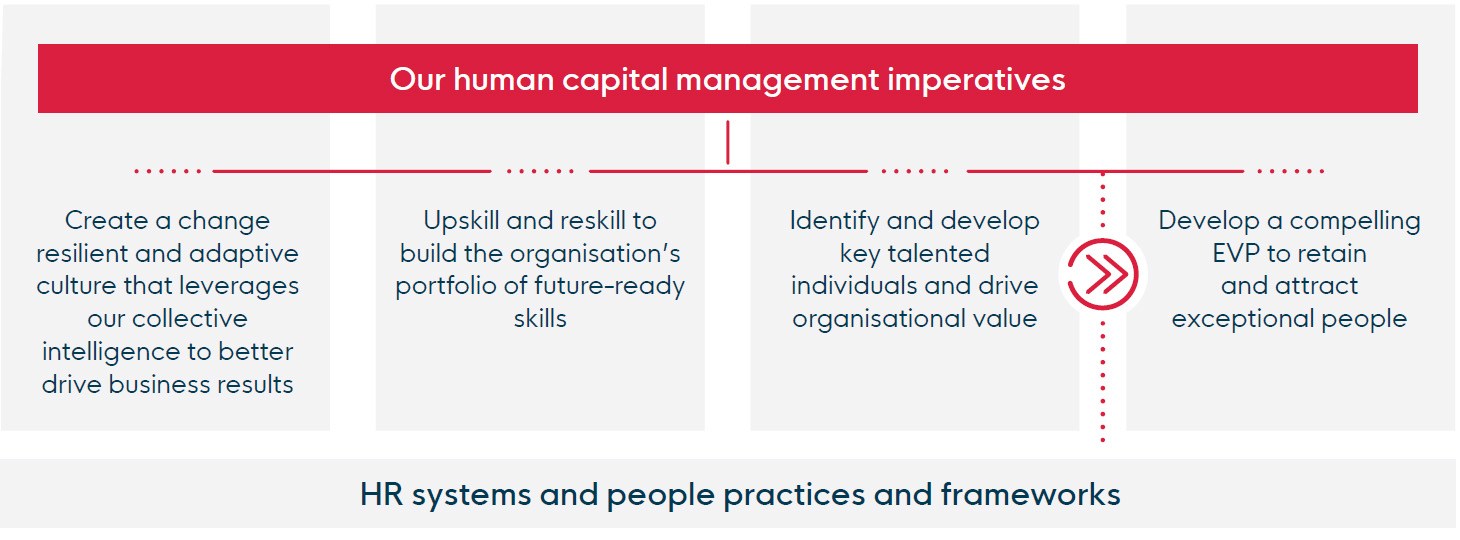
Our investments in human capital focus on training, developing and empowering our people, and improving our recruitment and training processes, succession planning and the way we measure employee performance.

Number of employees

17 283 people employed (2021: 16 708)

Leveraging a diverse and change resilient culture

We want to create a change resilient and adaptive culture that leverages our collective and diverse intelligence to drive deeper engagement, promote innovation, support business growth and improve productivity while ensuring the wellbeing of our employees.

To be truly inclusive, we must empower our people to make meaningful contributions, and treat all our employees fairly with equal access to opportunities, information and resources. We are working to embed DEI into the bedrock of our culture, business processes and talent management.

All interactions, including disciplinary actions and negotiations on terms of employment, are managed with utmost responsibility and in a fair, open and respectful manner. Various mechanisms are used to engage with employees, including employee engagement surveys and engagement initiatives within the individual businesses. For example, Mercedes Benz in the UK provides all employees with an application (app) on their phone so that they can share information about their activities. In South Africa, a toolkit helps our human resources personnel and business leaders to provide emotional support, communicate effectively, and embed our values and desired culture. In the UK, informal groups help address issues raised in employee engagement surveys.

Diversity, equity and inclusion

Our people policies convey the behaviours we expect of our managers and employees to provide a working environment where everyone can perform to their full potential. We ensure that our employment policies and practices do not unintentionally create potential for discrimination or unconscious bias behaviour. Policies are in place to accommodate the needs of people living with disabilities and to guard against harassment in the workplace.

In South Africa, our Employment Equity Plan supports social justice norms and labour legislation that drive the advancement of designated groups (Africans, Coloured, Indians, women and people living with disabilities). Since the Motus listing, the representation of South African black employees in management levels has grown considerably.

Black representation – South Africa


2018
%
  2022
%
Top management 25   50
Senior management 33   53
Middle management 39   50
Junior management 59   71

Our diversity training programmes in South Africa and the UK raise awareness on the value of diversity, empower managers to lead diverse teams and educate employees on how to work in diverse teams.

In South Africa, we have development programmes and learnerships that target women and people living with disabilities, and in the UK, our apprenticeships target women and people of colour. The Women in Leadership Programme (a partnership with the Gordon Institute of Business Science in South Africa) is a seven-month programme which develops women to effectively lead in a male-dominated environment. Participants gain insight from female industry and Motus leaders who share their career experiences and are assigned a coach to help them work on their personal development areas which are identified using 360-degree surveys.

Motus has a Diversity, Equity and Inclusion Roadmap in place. We held an externally facilitated workshop for the executives in South Africa to reimagine a purposeful DEI vision that engenders a better sense of belonging for employees. The workshop interrogated the collective understanding of DEI and the benefits of pursuing this culture. Similar sessions were held with the management teams of our business segments as well as with other key personnel. We were pleased that the results showed a common understanding of the value that DEI creates and that the feedback highlighted opportunities within each business segment. It has since been agreed that the DEI framework and tone will be set at a Group level, with the implementation thereof to be managed at business segment level.

2022 performance and key objectives

Employee engagement

  • In all operations good relationships and open communication exist between management and employees. Given the nature of our business, we feel that we gain better insight on employee concerns through individual business segment and regional employee engagement surveys rather than a Group-wide survey.
  • 78% of Kia's employees completed its culture and engagement survey, indicating a highly engaged workforce.
  • Retail and Rental is implementing interventions to address the issues raised by employees in last year's engagement survey, with particular attention paid to gender-related issues.
  • Mobility Solutions' employee engagement survey was answered by 424 (65%) out of 650 participants. Pleasingly, the survey shows that our employees understand Mobility Solutions' purpose and strategic objectives.

Diversity, equity and inclusion

  • Overall female representation grew by 7%, with the largest percentage increase being in Australia.
  • Women in top management positions led gender equity programmes launched in South Africa and the UK.
  • We are integrating gender perspectives to promote equity and guard against discrimination into the preparation, design, implementation and monitoring of policies and spending programmes in South Africa and the UK.

Gender diversity

32% of the workforce are women (2021: 31%)
33% of the Executive Committee are women (2021: 27%)
28% of our leaders (top, senior and middle management) are women (2021: 28%)
  • Included the increase of women representation at executive and management level in South Africa as targets in our new sustainability-linked facility.
  • Updated our anti-harassment policy to align to South Africa's new Code of Good Practice on the Prevention and Elimination of Harassment in the Workplace, which came into effect in March 2022. Our policy provides guidance on how to eliminate and prevent harassment and includes employee training and awareness on what constitutes harassment.
  • Launched the EmpowerHer Affinity Group to encourage women's networking beyond the Women in Leadership Programme and assist their journeys to success and empowerment.
  • A gender comparison study in May 2022 showed that 58% of our male employees and 55% of our female employees in South Africa have received training from Motus.

People living with disabilities (South Africa)

202 people, of whom 62% are black and 54% are women
(2021: 198)

Innovation and collaboration

Innovation is highly valued by our people. The mx platform – a digital innovation management platform – is central to our innovation strategy. It serves to deepen our innovative culture, enable cross-functional collaboration on innovative ideas and share innovation knowledge (keynote and thought leadership events, articles, practical innovation workshops, training and showcasing of innovative solutions). Business challenges are published on the platform, giving our employees the opportunity to share their ideas or generate solutions to the challenges. The mx community then votes and the popular ideas go into design. Viable concepts that pass adjudication by Motus executives receive sponsorship to mature into implementable projects. We also partner with institutes like the Henley Business School South Africa to grow our internal innovation capability.

mx platform

3 876 community members¹ (2021: over 3 900)
47 ideas shortlisted (2021: 15)
5 challenges held, generating 263 ideas, and
garnering 103 votes and 61 comments from
platform members
(2021: 7 challenges and 57 ideas)
23 concepts are at different phases of development
(discovery, validation and scale)
(2021: 12)

¹ Membership is impacted by the natural attrition of employees.

Building on World Creativity and Innovation Week, an important week for Motus given our focus on innovation, together with Think Wrong and Standard Bank, we hosted the Motus Xponential Blitz. The event brought together our employees, clients, partners and stakeholders to workshop sustainability-related ideas. The workshop was attended by 65 participants from Motus, Standard Bank, the education and technology sector, finance, innovation and telecoms and various NGOs, leveraging a diverse range of expertise.

Blitz participants collaborated on formulating solutions for real world South African challenges, that in turn, address some of the UN's 17 SDGs – specifically education and road safety. Blitz participants also explored new concepts, ideas, partnerships and products to drive impact.

Motus
Xponential Blitz

In 2022, we launched the CEO Challenge to drive engagement on the mx platform. Open to all employees in the Group, including our employees in the UK, the challenge aims to discover and recognise employees who are doing things in a different way. The challenges focus on efficiency, best practices and business improvement. Success stories are shortlisted and tested to determine whether they can be scaled across the relevant business segment to create value.

Doing things
differently

Building our portfolio of future-ready skills

A top priority for the Group is to develop and train our 17 283 employees so that they are knowledgeable and empowered to deliver our growth ambitions. Learning and development is also vital to their growth and development, and positively contributes to a more efficient, competitive and engaged workforce.

Digitisation is impacting skills and job roles. The future workforce will need to be change resilient. Employees will need digital and commercial astuteness, an increasing set of new skills and the ability to collaborate more to navigate increasingly integrated organisations. They will have to understand the digitally savvy customer and be able to educate the traditional customer. Our learning and development approach must therefore also become more agile to ensure organisational success.

For Motus this means we must understand our reskilling needs and ensure that our workforce has the capability and digital IQ to support a future-fit organisation across multiple platforms (digital dexterity). Big data and analytics, coding, design thinking, creative thinking, problem-solving and social platform sales and services skills are increasingly needed in the experiential workplace. Key is the digital capability of our sales teams; however, as dealerships evolve digitally, human interaction will still be critical at certain points to foster trust, knowledge transfer and other value-added services as well as deliver an enhanced customer experience.

Training and development opportunities

Tailored training and development opportunities are delivered at all employee levels. In addition to achieving our strategic objectives, our programmes support the achievement of our DEI targets and ensure a pipeline of skilled people for appointment to critical positions when they become available. In South Africa, each business segment manages its own technical and product-specific training, and the Group delivers non-technical training programmes.

Our Group-led programmes range from generic programmes that help employees deal with increasing uncertainty and complexity, to leadership and management programmes that focus on driving our desired leadership behaviours.

Digital astuteness

As the business model becomes increasingly digital and the technological component of most jobs grows, it is incumbent on the Group to build the digital dexterity of our employees. Programmes are needed to upskill lower skilled employees to ensure they can adapt to new ways of working, supporting their continued employment and enhancing their prospects of securing quality jobs. Our Digital Enablement Programme in South Africa teaches employees how to confidently navigate digitisation and use it to work more productively and effectively.

2022 performance

South Africa

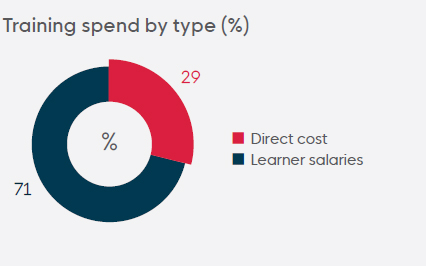
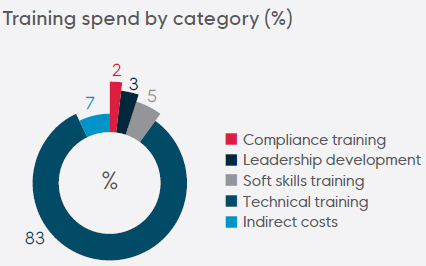
  • Training spend of R166,3 million equated to 3,4% of payroll - exceeding the Skills Development Act's requirement that training spend equal 1% of payroll (2021: R144 million; 3,2%).
  • Developed the Digitally Speaking Programme to create a shared understanding of the business and social needs for digital dexterity. The programme also develops digital competencies and will contribute towards creating an effective digital and innovative culture.

Training spend

Number of employees trained

7 490 employees trained, 57% of the workforce (2021: 6 415)

Hours of training

108 hours of training per employee (2021: 99)

Regions

  • Total training spend in the UK amounted to R122,3 million (2021: R123 million) and in Australia to R1,4 million (2021: R4 million). The combined training spend equates to 3,2% of the total payroll costs for the two operations (2021: 5,5%). Training in Australia was severely hampered by COVID-19 lockdown restrictions.
  • 196 apprentices are enrolled on the UK's apprenticeship programme with 83 recruited during the year (2021: 201; 59 enrolments).
  • In the UK, we launched the two-year Service and Maintenance Technician Programme to attract new talent into our workshops. Participants receive on-the-job training and a Level 1 Commercial Vehicle Technician status upon successful completion as well as the opportunity to study further. Motus Commercials also launched 70 apprenticeship vacancies, targeting young people (particularly school leavers) and women with positions in administration, sales, technical and customer services.

Our talent management framework

A healthy talent pipeline supports proper succession planning and future-proofs our leadership. It also facilitates the internal career growth of talented individuals who can contribute towards our strategic objectives. Talent management is about balancing new entrants and skill into the workforce while retaining experience and institutional knowledge.

Our succession plan is dynamic, and reviewed regularly at Group, business segment and regional level. Detailed succession plans are in place for top, senior and middle management roles.

Our talent mapping approach is designed to drive incremental business growth and support a more flexible approach to skills and workforce planning as new ways of working increase, while highlighting and fostering the development of key talent. Potential successors for critical roles are identified in our performance management process. This process also helps us ensure that our development programmes are fit-for-purpose and provides employees with the opportunity to voice and advance their career growth aspirations.

Leadership development

Our leaders play a critical role in effectively empowering employees and motivating high-performance teams. Our wide range of training, mentoring and networking opportunities provide a constant supply of increasingly experienced and capable leaders at all levels stemming from within the Group. Our programmes are designed to equip our leaders and potential leaders to exhibit the key behavioural and critical success factors needed to navigate successive levels of leadership right up to the Group CEO position. Our investment in our leaders is an investment in Motus' future and creates a ripple effect that positively impacts the Group's culture.

Our leadership development framework provides the basis for a structured approach to learning and development. It targets all levels in the organisation, from semi-skilled employees (leading self) to junior and middle management (leading others and leading functions), to senior and top management (leading the organisation and strategic partners). All programmes are underpinned by development assessments and 360-degree insights.

In addition, external development pipelines include technician programmes and apprenticeships, and learnerships including the YES4Youth Programme.

In the UK, our well-established Management Development Programme targets future leaders in middle and senior management identified as having high potential in the succession planning process. The five-module course focuses on self-awareness, people management, finance skills and customer handling.

2022 performance

Group

  • Conducted an in-depth analysis of succession coverage at senior and middle management levels. Good progress was made in updating the Group executive succession plan and plans are in place to address identified risks in employment bands beneath executive level.
  • Cross-functional and business segment talent exchanges were facilitated to support successor visibility and mobility. Financial directors are regularly moved between business segments and franchises to gain depth of experience and exposure to the broader value chain.

South Africa

  • Finalised the talent management playbook to guide businesses on how to effectively apply the Talent for Growth approach. The playbook covers talent attraction and retention, talent spotting for critical roles, talent development and succession.
  • Our recognised three-year Bachelor of Business Administration (BBA) degree in partnership with the Southern Business School was enhanced to digitally serve remote delegates. The BBA Programme was transitioned to a virtual learning model, ensuring that employees across South Africa have equal opportunity to enrol regardless of location.

Regions

  • In the UK, 19 delegates are participating in the Management Development Programme (2021: 15).

Leadership development

343 employees enrolled in
managerial programmes
(2021: 274)
71% delegates are black (2021: 65%)
42% delegates are women (2021: 38%)

Developing a compelling employee value proposition

Key for Motus is to provide a compelling EVP to retain and attract exceptional people and position the Group as an employer of choice within the automotive industry. This area of our people strategy is work in progress, and work is underway to define the Motus EVP.

Performance management

Our performance development approach drives better engagement between employees and their line managers, aligning employee standards of performance and expectations with strategic business objectives, and ensuring that employees are assessed fairly, developed appropriately and rewarded and recognised for exceptional performance. It also identifies corrective development or supportive actions to manage poor performance. Employees are assessed on their performance and values-based behaviour.

Fair remuneration

When necessary, we adjust roles and remuneration according to level of complexity, decision-making and skills required. This process enables us to empirically demonstrate the value of roles and jobs in relation to one another, regardless of the incumbent, and to defend our pay philosophy.

As part of the annual employment equity reporting cycle in South Africa, we assess the remuneration gap between the highest paid and lowest paid employees and at the same time identify if there are inequalities in remuneration in relation to race and gender in the various occupational levels. In the UK, we issued a report on the gender pay gap in 2022 and are taking steps to address gender pay equity.

Health, safety and wellbeing

We believe that investing in the safety, good health and wellbeing of our people maintains their morale and builds and improves our competitive advantage through their willingness and motivation to meet our strategic objectives and customer expectations.

Our occupational health and safety (OHS) procedures are closely monitored to ensure we remain vigilant and aware of where risks exist or may occur, as well as to ensure that they meet business requirements and comply with legislative requirements and guidelines.

In the UK, we have adopted the principles of ISO45001 (the revised OHS standard which includes environmental aspects) as our minimum standard.

We adopt a zero-tolerance approach to non-compliant OHS behaviour. Our employees are responsible for their own safety as well as the safety of others and are required to raise OHS concerns and non-compliance with their line managers and OHS representatives timeously. This includes what they feel may be potential hazards.

We recognise the importance of employees who are adequately trained, informed and supervised to fulfil their activities in a safe manner. OHS training and awareness is customised to the workplace environment of each business and region. Training ensures that employees clearly understand their OHS responsibilities, how to operate equipment safely and manage hazards responsibly, as well as adhere to legislative requirements.

In the UK and Australia, training is supplemented with method statements, toolbox talks and morning briefings. In the UK, we have three categories of OHS training: induction training for new employees, job-or task-specific training and refresher training. In Australia, all new employees complete online training on safe working procedures prior to starting work.

COVID-19 management

2022 was a year of navigating intense and differing responses to COVID-19 across our various operating jurisdictions. We were able to adjust our OHS practices accordingly to meet health authorities' COVID-19 guidelines and government regulations. COVID-19 measures are now included as part of our standard OHS practices.

COVID-19 vaccination is encouraged but not mandatory. We support vaccination given its proven ability to help reduce the chance of severe illness or death and the spread of the virus. As such, our employees are allowed time off work to vaccinate.

Supporting the wellbeing of our people

The physical and mental wellbeing of our employees directly impacts their performance and productivity. We provide preventive care and health education and awareness covering COVID-19 and the importance of mental health.

In South Africa, our Employee Assistance Programme is managed by external service providers. The confidential short-term counselling services help employees who are facing personal challenges, including financial and legal advice, and work-related problems that are affecting their work performance, and health, mental and emotional wellbeing. Beyond this programme, our people have access to a wide range of professional communication and self-leadership events.

In the UK, an independent occupational health provider oversees health surveillance interventions, including legislated medical examinations. The provider also assists employees who need counselling, help with stress and health issues, and rehabilitation from workplace accidents. The UK Employee Assistance Programme provides employees and their immediate family members with 24/7 access to a doctor, confidential counselling services, mental health support and professional financial advice. Advantageous savings and credit interest rates are available to those earning lower incomes.

Our Employee Assistance Programme in Australia comprises four counselling services and access to government bodies, which assist with relationship issues, depression, suicide and self-harm tendencies and domestic violence.

The commercial vehicles division in the UK has a network of 50 trained mental health first aiders, who have either attended a mental health awareness programme, a 12-week counselling course or a cognitive behavioural therapy course. Their role is to destigmatise mental health problems, encourage our employees to speak up and serve as contact points for employees struggling with their mental health. Where required, the first aiders direct employees for professional support.

Mental health
first aiders
in the UK

2022 performance

Group

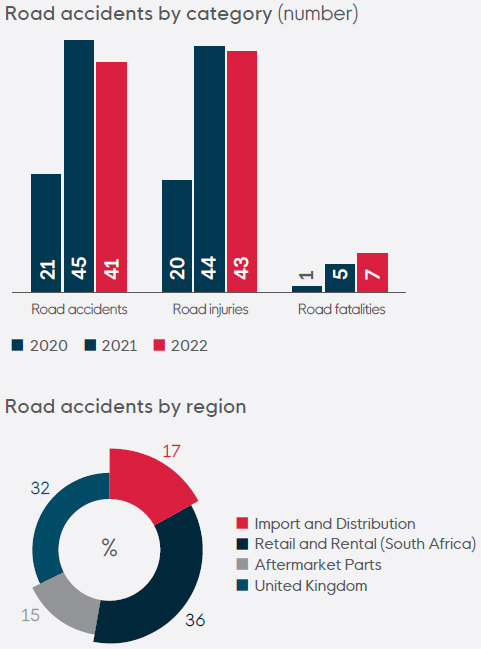
  • Road incidents (damage to property but no injuries or fatalities) increased by 42% to 616. Accidents per million kilometres decreased from 0,263 in 2021 to 0,236. Of the 41 road accidents, 28 occurred in South Africa and 13 in the UK.
  • The increase in business activity and travel has unfortunately resulted in road fatalities increasing to seven (2021: five) (two employees and five third parties). The fatalities resulted from six separate road accidents in South Africa. Of the five third-party fatalities, four were pedestrians. In addition, one of our vehicles was involved in a multi-vehicle accident in which four adults died.
  • 290 onsite incidents were reported (damage to property but no injuries or fatalities) up 49% from 2021, as business returns to more normal trading levels. The UK recorded 242 (2021: 161) incidents with 41% (2021: 31%) being third-party error.
  • Onsite accidents increased 38% from 199 in 2021 to 274 (the breakdown shown in the graph below). 7% of onsite accidents were third-party error (2021: 5%). The majority of injuries reported in the UK are slips, trips and falls at 18% and operator error at 17%.
  • There were no material incidents of non-compliance with OHS regulations.

OHS audits

547 sites (2021: 526)
92% audit coverage (2021: 97%)
93% average score (2021: 92%)

Onsite accidents (number)

Road accidents

Vaccination

Over 75% average vaccination rate across all business
segments in South Africa

In the UK we are restricted from asking about
vaccination status and estimate that around 85%
of our employees are fully vaccinated in line with
the national average.
98,5% of our employees are fully vaccinated in Australia

Transformation

The automotive industry adds real value every day -providing mobility, facilitating trade, creating sustainable jobs, moving people, goods and services, serving communities and creating prosperity for South Africa's people. Motus' socio-economic objectives, particularly in terms of fiscal contribution, people development and community-based projects are designed to support the transformation of South Africa's automotive industry.

Effective economic inclusion and transformation can only be achieved with collaboration between the South African Government and the private sector. We support the Automotive Aftermarket Guidelines, which aim to expand the inclusion of SMEs owned by black individuals in the automotive aftermarket value chain as well as increase local production volumes and create jobs. As small businesses play a critical role in creating desperately needed jobs, it is government's intention to grow local production and manufacturing, and open big business supply chains to SMEs.

South Africa's automotive industry bodies promote the sector's interests and ensure a competitive yet collaborative industry. Our industry body memberships enable us to share our expertise and experience to support broader national strategies and progress the transformation of our industry and enrich its leadership. They also provide us with insight to the perspectives of other industry leaders and allow us to identify opportunities to drive our own transformation initiatives and contribution to society at large, over and above our community initiatives.

Our transformation strategy

Our Level 4 B-BBEE rating supports our commercial competitiveness and secures our relevance in South Africa's society as a business that positively contributes to the economy and communities.

Ownership is an important factor for organisations making purchasing decisions in South Africa, as buying from a company that is at least 30% black women-owned or 51% black-owned improves the customer's preferential procurement score. Having the best possible B-BBEE rating and ownership level therefore enhances our relevance and ability to compete.

Given the high level of our procurement spend linked to franchise agreements or OEMs, OEM scorecards have a knock-on effect on our points for procurement. South African OEMs have committed to the Equity Equivalency Programme that aims to improve their contributor status to a minimum Level 4 B-BBEE rating. This should positively impact our B-BBEE scorecard and rating.

Transforming our workforce

Our long-term objective is to have a local workforce that is reflective of South Africa's economically active population by 2028. Our key focus is to increase the number of black people and black women in management positions and continue to develop the skills of our black employees.

See the progress the Group has made in transformation since listing.

Our Employment Equity Plan sets out co-ordinated and targeted interventions to recruit, develop and promote candidates to achieve our race, gender and disability targets. We ensure an appointment, promotion and training ratio of over 50% in favour of employees from designated groups.

Supporting black-owned and managed businesses

We are developing sustainable working models for black-owned and managed businesses, including non-OEM branded workshops and majority black-owned dealerships, in historically under-served areas near and around informal communities. We are also making our parts and services more accessible to informal traders and technicians. Not only do these initiatives aim to support communities, but they also provide us with access to new markets.

Our enterprise and supplier development strategy is to find opportunities within our controllable procurement spend categories (that is outside of our franchise and OEM procurement) to provide training, mentoring and financial assistance to SMEs, particularly black-owned enterprises, to help them build sustainable businesses.

2022 performance

B-BBEE rating

Level 4 B-BBEE rating at corporate level valid to 28 September 2022
Target: we expect to maintain our Level 4 rating for
the 2022 B-BBEE scorecard
Included in the Satrix Inclusion and Diversity Exchange Traded Fund

Composition of the overall workforce

75% of the workforce is black (2021: 73%)
24% of the workforce are black women (2021: 23%)

Skills development

R128 million 77% of training spend in South Africa was used to develop black people (2021: 72%)

Preferential procurement

R71,5 billion total procurement spend, of which 29% was categorised as controllable (2021: R56,7 billion; 35%)
65% of our controllable procurement spend was with preferential suppliers (2021: 63%)
R2,9 billion spent with >51% black-owned businesses against an internal target of R2,5 billion (2021: R2,3 billion)

Enterprise and supplier development

R121 million invested in enterprise and supplier development, a 59% increase compared to prior year (2021: R76 million)

Community upliftment

We firmly believe that we can use mobility for good to drive positive socio-economic impact, strengthen our relationships with our stakeholders, create employment, grow the automotive industry, and make a difference in the lives of our people and communities.

Our CSI supports initiatives that will make a long-lasting positive difference to the economies and communities in which we operate. Our chosen pillars are education and skills development, road safety and primary healthcare - areas we believe will assist to alleviate the needs of these communities. Each year, we aim to allocate 70% of our CSI spend to Group projects in these pillars to ensure we achieve a meaningful impact. Individual businesses within the Group support additional projects that meet the specific needs of their local communities.

2022 performance

Group

CSI spend

R30,0 million invested in CSI (2021: R18,6 million)

Included in CSI spend

R6 million donated through Gift of the Givers to communities
in KwaZulu-Natal who were either impacted by the
July 2021 unrest (R3 million) or by the floods that
ravaged the province in April 2022 (R3 million1)

¹ With Hyundai Automotive South Africa and Hyundai Motor Company of South Korea.

Socio-economic development spend (B-BBEE)

91% (R28 million) of our CSI spend is estimated to qualify for the 2022 B-BBEE scorecard's socio-economic development pillar, equating to 1,1% of NPAT, meeting the dtic Codes' target of 1% of NPAT (2021: R17,5 million; 1% of NPAT)

¹ NPAT: Net profit after tax

Scored 5 out of 5 points for the socio-economic
development pillar of the 2021 B‑BBEE scorecard

Driving road safety education and awareness

Our Road Safety - powered by Motus initiative drives road safety education and awareness among school children, parents and holidaymakers in South Africa. We partner with leading road safety advocates and the government to change the behaviours of road users towards more responsible road usage. This is delivered through three key programmes:

The Safe Scholars Programme1

This delivers memorable life-saving road safety messages in a fun and interactive way for primary school children and their teachers. Around 18 schools were visited each month. In response to COVID-19, this initiative was expanded to include health and hygiene messaging.

¹ Supported by the Department of Basic Education and the Department of Transport.

Impact since 2011

Over 1,96 million learners reached in over 2 300 schools (2021: over 1,75 million learners reached in over 2 080 schools)

We estimate that we will achieve the milestone of two million learners reached towards the end of the 2022 calendar year.

The Highway Patrol Programme

We provide the Bakwena Platinum Corridor Concessionaire with patrol vehicles to assist the concessionaire with 24-hour visible policing and faster response times to incidents (crashes and breakdowns), along the N1/N4 toll routes – the busiest toll routes in South Africa during the Easter and December holiday seasons.

Wheel Well

Renault is Wheel Well's drop-off point of choice for parents wanting to donate used baby car seats. Wheel Well then refurbishes the seats and donates them to people who cannot afford new car seats.

Community health and wellbeing

We invest in the Unjani Clinics network, which empowers black women professional nurses to operate and ultimately own primary healthcare container clinics in their communities. The clinics provide affordable, quality primary healthcare and medicines to those who are uninsured and under-served but employed and able to pay a small fee towards their healthcare needs.

26 clinics added to the Unjani Clinics network, as well as four mobile units and health pods, in 2022
124 healthcare facilities located across South Africa (2021: 98)
864 122 patients served in South Africa during the year (2021: 677 161)
Over 2,9 million consultations since 2010, with an average of 74 080 patients provided with primary healthcare a month (2021: over 60 700 patients a month)

Education and technical skills development

Our investments in high-quality education and skills development do not only address this societal imperative and provide young people with entrepreneurial and commercially viable skills, but they also help build self-confidence and self-esteem and a stronger pool of talent from which Motus and the automotive industry are able to source tomorrow's leaders. We achieve this through three main initiatives:

The Motus Technical Academy

Apprenticeships

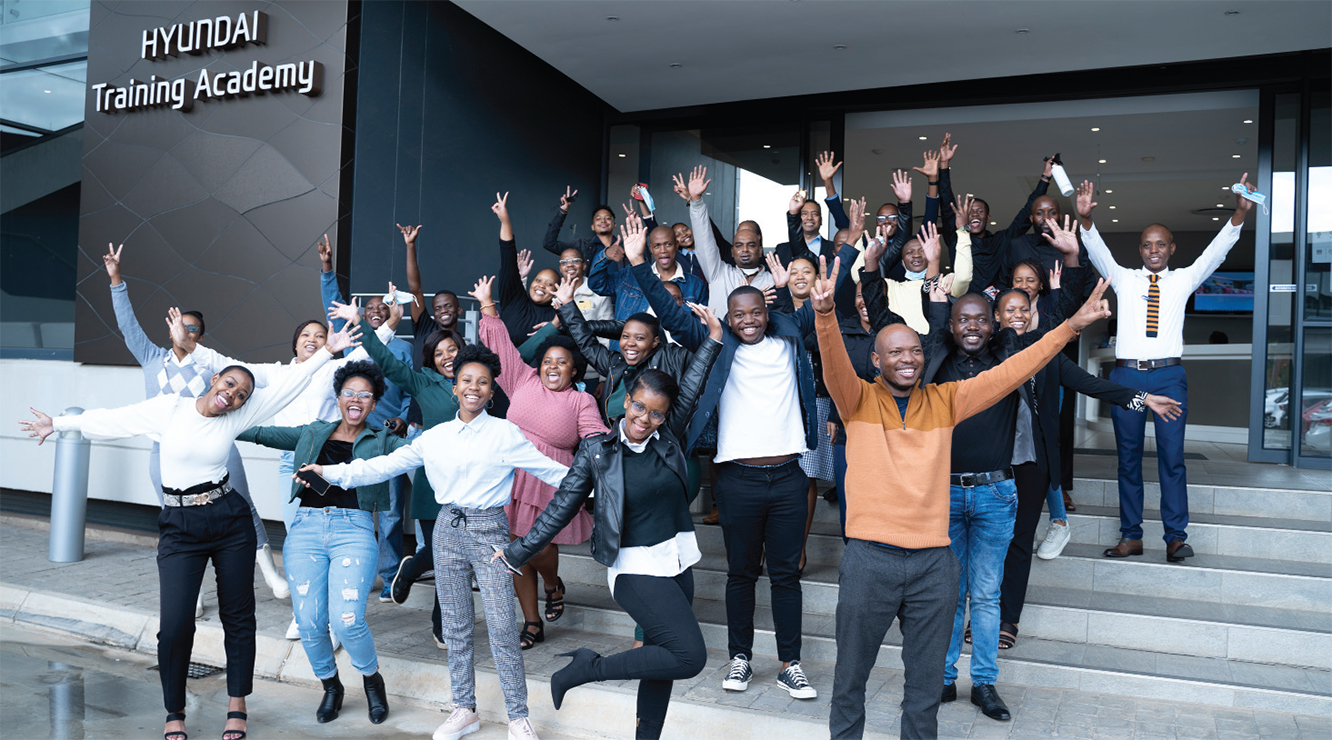
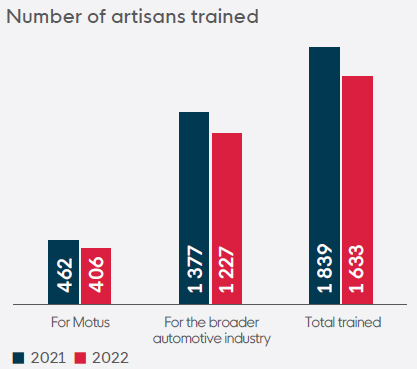
As the largest training academy for motor artisans in South Africa, it offers full apprenticeships and learnerships for motor, diesel and motorcycle mechanics, auto-electricians, and spray-painters, as well as skills programmes and short courses. Our accredited artisan training institutions in Gauteng, Western Cape, and Bloemfontein (four institutions in total) train around 1 600 apprentices and technical workers annually for both Motus and the broader automotive industry.

The Motus Family Bursary Fund

This assists qualifying employees in South Africa with the costs to send their children to selected South African tertiary institutions from the second year of study onwards.

R9 million disbursed through the fund over three years (2020 to 2022)
27 beneficiaries supported in the 2022 calendar year. Students receive a maximum amount of R45 000 (2021: 6)

The Imperial and Motus Community Trust

The Trust builds and maintains school libraries and resource centres to encourage reading and promote higher literacy levels at under-resourced public schools in Gauteng, South Africa. We have committed to investing a minimum of R5,5 million in the Trust each year to 2025. Motus brands provide funding over and above this amount.

63 school libraries and resource centres (2021: 52)
>72 000 learners reached (2021: over 61 300)

Detailed information

Read our full environmental, social and governance report online.