


 ENVIRONMENT
Environmental report




Berenice Francis
Corporate Affairs, Risk and Sustainability
FTSE4Good Index Series
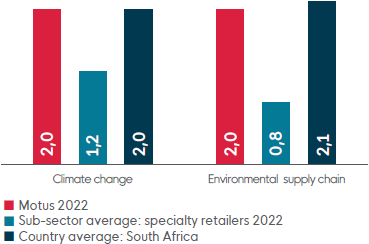
Motus aims to ensure that our strategy is achieved in an environmentally conscious and responsible manner, by managing activities that impact the environment and actively striving to uphold our commitments to all stakeholders.
The Motus values require us to be conscious of our environmental impacts when making business decisions and investments. Care for the environment is also included as part of our strategic pillar – to invest in human capital and ESG initiatives. We responsibly manage the environmental impacts within our control, contributing towards the urgent action needed to address the potential damages caused by climate change.

- Deliver on our environmental strategy: renewable (solar) energy and rainwater harvesting.
- Meet our environmental targets for water, fuel and electricity.
- Set a group-wide baseline for waste management and recycling to improve our waste management approach.
- Drive key projects to reduce our environmental footprint and improve our
Motus is not a carbon or water-intense business. Our strategies for water and energy consumption are specific, measurable, achievable, relevant and time bound (SMART). Over the past year we started working on expanding our environmental strategy to include a more consistent and managed approach to recycling and waste, particularly as stakeholder expectation grows that companies participate in the circular economy.
We have also for the first time reported against the TCFD requirements. An externally facilitated assessment was conducted in 2022 on our ESG maturity, particularly focusing on our environmental reporting, to identify gaps with stakeholder expectations and the disclosure requirements of our selected as well as emerging reporting frameworks and standards. Closing these gaps will be a key objective for the Group in 2023.

Detailed information
 Read more about our approach to managing climate-related risks in our governance report.
 Environmental targets
During 2022, we set new three-year environmental targets to 2024 for water, electricity and fuel. Our targets are based on normalised trading activity prior to the COVID crisis. To ensure that our targets are fair and realistic, they will be adjusted annually for footprint changes (acquisitions, disposals and movement between business segments) and site-specific activity.
| 2022 Stretch target |
2023 Stretch target |
2024 Stretch target |
|||
| Water (kilolitres) | 554 999 | 538 349 | 522 199 | ||
| Electricity (megawatt hours) | 69 712 | 67 621 | 65 593 | ||
| Vehicle fuel (litres) | 18 531 442 | 18 336 683 | 17 786 582 |
To simplify our measurement and reporting, we realigned the targets of our first sustainability-linked loan and linked our new Rand-denominated facility to our new three-year Group targets. Our loan-linked targets were then extended to include a gender diversity target.
| Baseline | 2023 | 2024 | |||||
| Group | |||||||
| Water (kilolitres) | 611 223 | Stretch: 12% – 538 349 – 538 349 |
Stretch: 15% – 522 199 |
||||
| (2019) | Threshold: 5% – 581 417 |
Threshold: 10% – 548 309 |
|||||
| Electricity (megawatt hours) | 80 146 | Stretch: 16% – 67 621 |
Stretch: 18% – 65 593 |
||||
| (2019) | Threshold: 11% – 71 003 |
Threshold: 16% – 67 233 |
|||||
| Vehicle fuel (litres) | 22 250 296 | Stretch: 18% – 18 336 683 |
Stretch: 20% – 17 786 582 |
||||
| (2019) | Threshold: 13% – 19 253 517 |
Threshold: 18% – 18 231 248 |
|||||
| South Africa | |||||||
| Female representation | 26% | Stretch: 8% – 34% – 34% |
|||||
| (top, senior, middle and junior management) | (2021) | Threshold: 6% – 32% |
Still to be | determined | |||
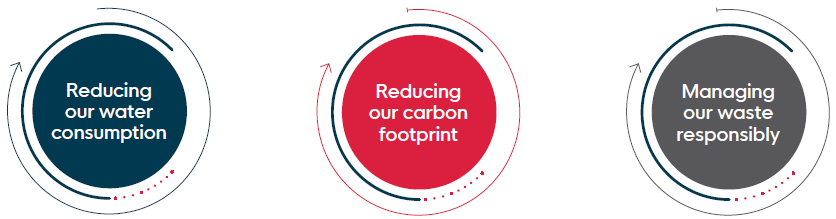
Our environmental strategic imperatives
 Reducing our water consumption
Finding ways to use water efficiently and lower our reliance on municipal water sources, reduces our operational costs and ensures business continuity even when water restrictions are in place or our operations face drought conditions.
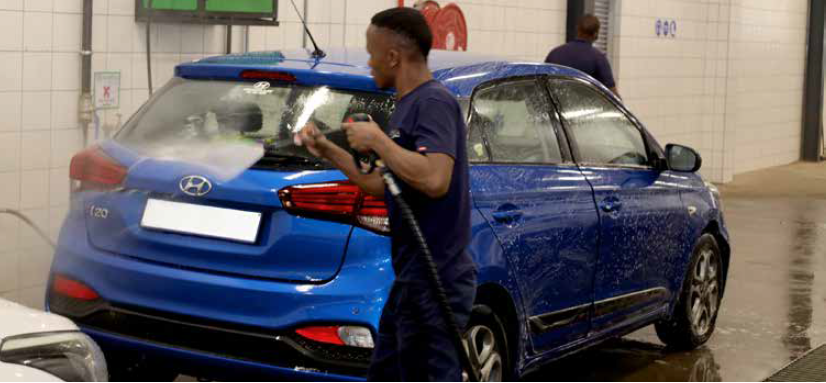
In South Africa, independent smart water meters are installed in some dealerships, particularly those sites where rainwater harvesting systems have been installed. Water harvesting and wastewater recycling systems are implemented in the wash bays of some dealerships in South Africa and Australia, and Car Rental branches in South Africa. Boreholes also serve as alternative sources of water at certain dealerships.
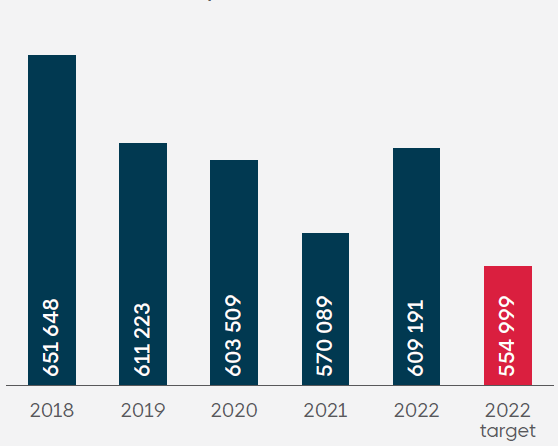
Water consumption (kilolitres)
Purchased from municipalities
Water consumed from alternative sources
(2021: 1 701)
| 1 | Reported for the first time. |
- We missed our year one (2022) water consumption target by 9,8%. Across the Group, water consumption increased 6,9% compared to 2021 with South Africa increasing 7,6%. These increases are mostly due to a return to normal trading activity, changes in uses of certain facilities and increased vehicle fl eets following lower levels of activity during the fi rst two years of the COVID-19 pandemic.
- Our new multi-franchise dealership in Pretoria is fi tted with seven 10 000 litre EcoWash tanks (three used in the wash bay and the remaining four used to harvest rainwater). The multi-franchise’s wash bay retains 80% of the water used in a wash cycle.
- We have set a new internal stretch target per site to reduce water consumption by 9% over three years to 2024.
- In South Africa, we are working to improve our reporting of water consumed from alternative sources and recycled water.
Reducing our carbon footprint
An energy-efficient building is generally a better environment in which to work and is significantly less expensive to run. We are analysing where solar PV installations are feasible within our site network so that we can reduce costs, contribute towards taking electricity demand off the national grid and assist South Africa to meet its international obligations to combat climate change.
Over the past couple of years, we have been installing energy-efficient technologies across our footprint. In South Africa, around 80% of our sites have implemented energy saving lightbulb replacement programmes. In certain operations, we are implementing natural light harvesting projects where sensors adjust the brightness of lights based on the amount of sunlight entering an area. Electricity meters are also used at many sites to monitor consumption, identify spikes and energy-saving opportunities.
Group carbon footprint (tCO2e)
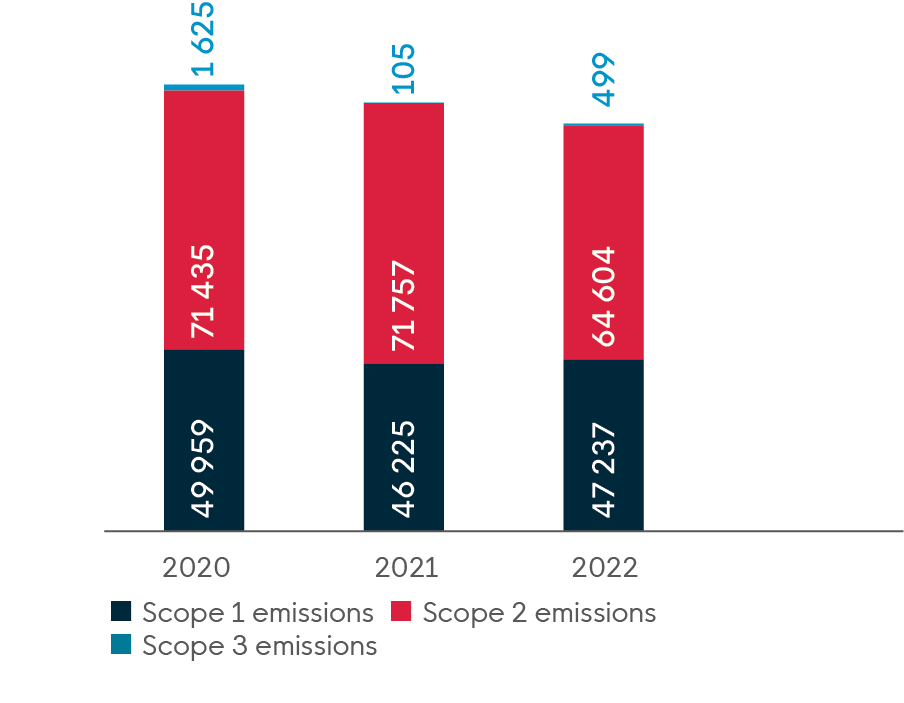
| Note: 2020 and 2021 restated due to a change in carbon emission factors applied to better reflect the South African environment. |
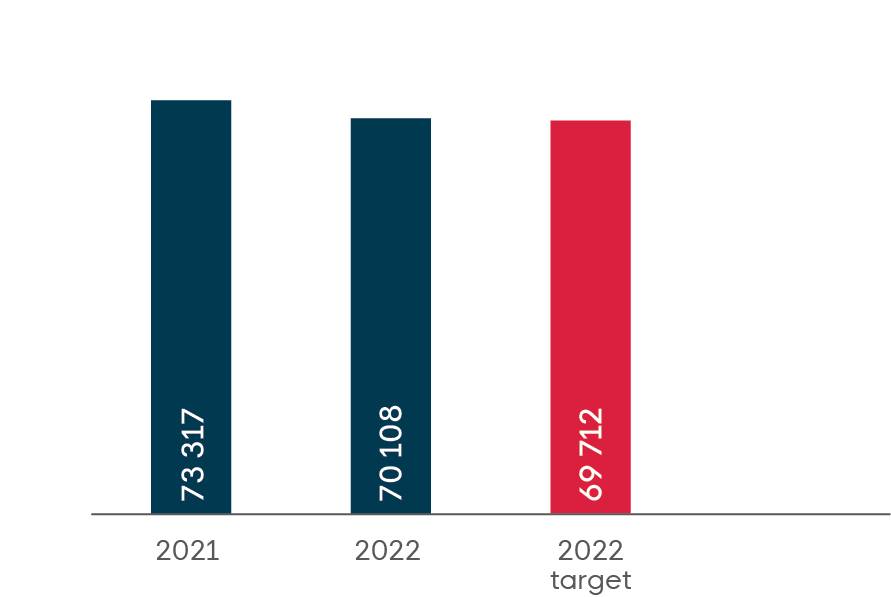
Electricity consumption (megawatt hours)
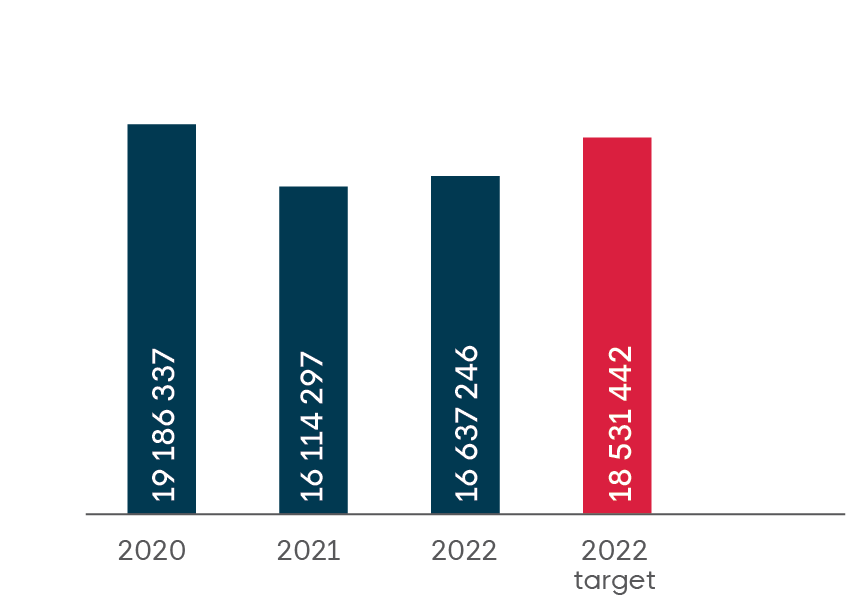
Group fuel consumption (litres)
- The 4,9% reduction in carbon emission is pleasing against year-on-year revenue increase of 5,5%. The marginal increase in Scope 1 emissions was due to increased road fuel usage and the increase in Scope 3 emissions due to increased business travel as activities resumed following the lifting of COVID-19 restrictions.
- Electricity consumption was 0,6% above target. At Group level usage decreased 4,4% at Group level compared to 2021 with South Africa consuming 5,9% less electricity. Despite an increasing footprint in 2022, the solar PV projects implemented over the past two years have resulted in a continued decrease in our purchased electricity consumption.
- Road fuel consumption was 10,2% below target, and 3,2% higher across the Group compared to 2021. Road fuel consumption in South Africa increased 6,9% compared to last year. These increases are mostly due to increased trading activity following the impact of COVID-19 and employees with company vehicles returning to the office environment.
- As we mature our energy efficiency and renewable energy projects, we will start to ready the Group for a net zero carbon emissions plan and develop carbon emissions targets for the South African operation. In our regional operations we will align to national targets and OEM product guidelines.
- We have taken the first step to reporting carbon emissions intensity indicators for the Group.
- To reduce our carbon footprint, we set a new internal stretch target to decrease electricity consumption by 11% and limit our use of vehicle fuel to a 6% increase over three years to 2024.
- We have identified some good opportunities to potentially roll out solar PV solutions at some of our larger dealership sites in the UK.
- A solar solution is being implemented at our multi-franchise dealership in Traralgon, Australia.
Managing our waste responsibly
We manage hazardous and non-hazardous waste responsibly, complying with applicable waste management laws in all jurisdictions of operation and ensuring that relevant disposal certificates are received.
To reduce paper consumption and correctly sort waste at source to reduce waste going to landfill requires behaviour change. Traditionally the vehicle selling process was a paper-intensive exercise. However, as advances in technology make it possible for us to automate more of our business processes, we eliminate duplication of processes and reduce the amount of paperwork, while still ensuring that regulatory requirements and customer needs are met.
Key projects like Motus Digital Dealer and our digital identity tool digitise the customer’s interaction with Motus, enhancing customer experience and enabling customers to digitally provide us with their information. Given that a full vehicle purchasing transaction with policies averages between 150 and 200 pages of paperwork, Motus Digital Dealer and our digital identity tool are expected to result in significant paper savings within the dealership network.
Waste recycled – South Africa
of batteries (either returned to suppliers or recycled), 2,4 million litres of oil, 1 037 421 kgs of paper and 63 016 tonnes of tyres
Waste recycled – UK
- In South Africa, we increased our focus on waste management at dealership level, launching a recycling initiative to reduce the amount of waste sent to landfill.
- In the UK, we narrowly missed our 2022 target of 98% (2021: 97%). This is still a pleasing performance given that our consumption increased year-on-year due to the return to normal business activity following COVID-19 lockdowns.
- We are working to achieve consistent and accurate measuring and reporting for paper, plastic, tyres, batteries and oil, following which we will set waste targets.
- In South Africa, we are developing an eWaste recycling programme.
 Read our full environmental report online.
We acknowledge that we operate in an industry that must adapt to become a sustainable contributor. OEMs are introducing NEV models in their product ranges, particularly full and plug-in hybrid electric vehicles. As an importer and dealer representative of automotive manufacturer products, we have limited influence on NEV production. However, we keep abreast of the shifts that our OEM partners are making in their transition to plug-in battery-powered electric vehicles, so that when policy changes are implemented in our regions of operation, we are able to quickly add these types of vehicles to our portfolio.
Aggressive NEV adoption targets will require a change in our portfolio of products, with the timing being dependent on OEM roll out and each country’s regulations. We monitor the availability and pricing of NEV models and competitor activity which may indicate a shift in market readiness. We also contribute to national policy development and have provided feedback through naamsa to the Department of Trade, Industry and Competition (dtic) on its draft New Energy Vehicle Green Paper.
Read more about our approach to NEVs in the environment chapter of the ESG report .

OEM
transition
shifts