


Chief Executive Officer's review

The Group has performed strongly over the past three years, demonstrating an ability to find opportunity in even the most challenging circumstances.
Osman Arbee
Chief Executive Officer

"Strategic agility and entrepreneurial leadership drove an exceptional performance in challenging circumstances – something I am proud to say again this year. Our results affirm the resilience and differentiation of Motus' business model, and the flexibility it gives us to position the Group for sustained profitable growth in a dynamic environment."
Earnings per share
growth of 65% to
Free cash flow generated
from operations
Net debt to EBITDA
Required: to be less than 3 times
Operating in an unpredictable world
The agility we showed in response to the pandemic, now a feature of how we do things at Motus, combined with our competitive advantages of scale, integration and differentiation, and the strength of our entrepreneurial leadership team, gives the Group its resilience and positions it for future growth. We set this expectation with confidence, despite an uncertain outlook for the world and tough times for our domestic market.
The Group has performed strongly over the past three years, demonstrating an ability to find opportunity in even the most challenging circumstances. Four themes underpin this resilience in market conditions that demand hands-on day-to-day involvement from the Group leadership:
Motus' integrated business model enables us to capture opportunities when others face challenges, within the parameters of good governance and guided always by our strong moral compass.
Motus' ability to adapt and innovate, specifically by accelerating the digitisation of front-end services and back-office processing, enables us to respond rapidly to changes in consumer buying preferences and to stay at the forefront of mobility services.
Motus' enduring and long-standing relationships with OEMs, suppliers and other stakeholders enables us to limit the impact of erratic product supply. The funding from financial institutions to fund our customers and Motus allow us to implement our growth strategies.
Motus' people continue to demonstrate the entrepreneurial flair and commitment to professional standards that have been the hallmark of the Group's character for 75 years.
These characteristics will continue to support the Group's ability to respond dynamically to an unpredictable environment; economic, social and environmental volatility will remain a feature of the 'new normal' even as the COVID-19 crisis recedes.
Globally, central banks are facing challenges in curbing inflation, expected to translate into rising interest rates over the short to medium term. The longer-term effects of the pandemic continue to impact emerging markets disproportionately, with challenging market conditions including rising interest rates and escalating costs of labour, energy, fuel and raw materials. The ongoing Russia-Ukraine conflict has heightened supply challenges, putting additional pressure on fuel and food supply chains, and dampening global growth forecasts.
Performing under pressure
Results for the year reflect strong strategic and operational achievements, demonstrating clearly the benefits of the Group's integrated business model. The strong positions of our businesses, which cover the full automotive value chain, and our integrated approach across the vehicle ownership cycle, which gives us many opportunities to serve our customers' mobility needs, diversifies our revenue and profit streams and enables us to cross-sell and leverage opportunities. This makes the Group highly cash generative, and in turn allows us to invest in growth opportunities.
Revenue (Rm)

Operating profit (Rm)
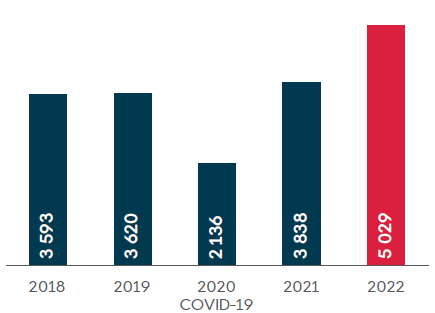
In South Africa, naamsa1 reported that new vehicle sales volumes remain subdued, albeit with more stability as market recovery gains momentum. New vehicles retailed were up 10% to 490 124 vehicles for the 12 months to 30 June 2022.
New vehicle sales projections for the coming year indicate a steady improvement, with estimates of between 530 000 to 550 000 for the 2023 calendar year.
As the automotive industry contributes around 4,3%1 of South Africa's annual gross domestic product (GDP), this recovery reflects the resilience of consumers amid relatively favourable credit conditions, and the willingness of the South African businesses to invest in the country's longer-term economic sustainability. The South African economy grew by 4,9%2 during 2021, and real GDP growth of around 1,8%3 is expected for 2022, indicating a protracted recovery.
The outlook for the UK is less favourable as increasing energy costs, higher interest rates, higher personal taxes and accelerating inflation will constrain consumer spending in the short to medium term. Despite a decline in the new vehicle market of 18,2% for the 12 months to 30 June 2022, Motus has been able to maintain its retail market share.
Australia follows the same theme, with rising prices of fuel, food and other consumables driven by global supply challenges, ongoing lockdowns in China and the recent floods. The market declined by 2,1%4 for the 12 months to 30 June 2022, with Motus doing well to maintain its retail market share in the highly competitive Australian automotive industry.
The global automotive industry, already impacted by shortages of semi-conductors, is expected to experience ongoing supply chain pressure. Some large OEMs halted production at the onset of the Russia-Ukraine conflict due to shortages of components supplied from the Ukraine and surrounding areas; and in South Africa, the floods in KwaZulu-Natal resulted in Toyota destroying 4 500 vehicles and no production for four months.
Despite shortages of certain derivatives and vehicle models, our long-standing relationships with OEMs and vast brand portfolio and model range allows us to offer customers a wide selection of alternative vehicles. We anticipate that inventory supplies will normalise in the middle of the 2023 calendar year.
| 1 | naamsa | The Automotive Business Council. |
| 2 | International Monetary Fund | World Economic Outlook, update July 2022. |
| 3 | Nedbank Group | Unaudited Interim Results 2022. |
| 4 | Federal Chamber of Automotive Industries (fcai.com.au). |
Accelerating sustainable growth
Our longer-term strategy remains unchanged, and the strategic priorities are designed to deliver sustainable growth. Our focus will be to responsibly grow the Group's multi-national footprint, and to continue leveraging the benefits of digitisation and innovation.
The development of digital solutions that find better ways to meet customer needs has become a tangible feature of our culture, generating sustainable competitive advantages that span our businesses. We are investing in digital innovation to improve processes and deliver efficiencies across the vehicle retail experience; innovative ideas that make the vehicle purchasing process smoother for customers and retailers alike, freeing up time to improve the customer experience and deliver the value-add that differentiates the buying process and engenders loyalty.
The integrated nature of the Motus business model creates multiple touchpoints for the Group with our customers. Each of these interactions is an opportunity to introduce additional services to meet customers' needs. This is most evident when a customer purchases a new or pre-owned vehicle, and products such as extended warranties are introduced. Similarly, service centres introduce a discussion of a trade-in of the vehicle to a newer vehicle.
Motus' comprehensive range of brands also contributes to the Group's ability to respond to market shifts. Whether the economy drives people to buy up or down, as has been the case recently, Motus has a product or service to match. For instance, the introduction of premium vehicle models in our Importer brands has supported our response to the structural transition of customers buying away from luxury brands.
As such, when market conditions and consumer confidence support vehicle sales – whether new or pre-owned – Motus' vast range of dealerships, comprehensive product offering, and online presence effectively capture market share. And when market conditions encourage customers to keep their vehicles for longer, Motus' services and aftermarket parts businesses help its customers to keep their cars for longer.
We continue to leverage these benefits to deepen our competitiveness and relevance across the automotive value chain, driving organic growth through optimisation, innovation and selective bolt-on and complementary acquisitions. In October 2021, we completed the acquisition of FAI Automotive plc (FAI) in the UK, allowing us to expand our Aftermarket Parts business offering. FAI's product line is similar and complementary to our business, with a well-established and growing private label offering, and the synergies created have allowed us to leverage our combined buying power to procure products at competitive prices.
Our dealership acquisition strategy will continue to focus on selective bolt-on dealerships in areas where we can improve brand representation across all geographies. We recently opened our flagship multi-franchise dealership in Menlyn, Pretoria – our single biggest multi-franchise dealership to date.
Progress in our digital and innovation journey saw us acquire an additional 11% in getWorth, bringing our total investment to 60%. We continue to see the benefits of this investment as we integrate it further into our digitisation approach. We also acquired 25% in a technology company, to gain access to complementary technology and expand our offering.
Accelerating digitisation and innovation
The pandemic precipitated a rapid and lasting change in customer vehicle-buying behaviour. While our physical dealership network remains indispensable in finalising transactions, customers now do most of their research and short-listing online. This shift in consumer behaviour demanded that we accelerate the digitisation process that had already begun.
Our innovation and digitisation efforts accelerated in the past year. We invested in systems, and in our people, who use them. Thanks to digitisation, information technology is no longer a support function but a critical business enabler that allows us to exceed expectations. For this reason, the omni-channel approach will play an increasingly important role in the broader purchasing process. Already, customers can complete most of the vehicle purchasing process online – from selecting a preferred vehicle to applying for finance. Despite this, there are some aspects of the purchasing process that are challenging to digitise. The need for a physical dealership to complete the transaction, as part of the omni-channel approach, remains vital.
Motus sets itself apart from its competitors by positioning itself at the forefront of various sales channels across the spectrum of new and pre-owned vehicles, traditional dealerships, online channels and warehouse retailing. This is particularly important given the emergence and rapid adoption of online sales platforms and warehouse retailing.
As the first online brand launched by a retail automotive group, motus.cars is rapidly gaining functionality and customer acceptance. Launched in 2020 to streamline the pre-owned vehicle purchasing process, it is currently a significant lead generator for the Group, representing 23 OEMs and over 300 dealerships around South Africa. We own all the vehicles on the site and motus.cars can be scaled as consumer preferences shift. It also lists thousands of pre-owned vehicles, a vast majority not older than six years.
Our investment in getWorth supports our positioning in the online vehicle buying and warehouse retailing space. Leveraging the data technology and machine learning capabilities of getWorth, we can extract insights from large data sets about customer behaviour and vehicle data to develop innovative value-added products. Our ability to blend technology, data and product thinking will allow us to build on the capabilities we have to create a truly seamless online customer experience.
Beyond the retail sector, we expect the emergence of shared mobility solutions (ride-sharing, vehicle subscription and e-hailing) to depend significantly on market-leading technology platforms. Cars connected to the internet will generate more data, which will need to be managed better to create further opportunities to monetise it.
Innovation across the Group is managed internally by leveraging existing capabilities to create efficiencies, reduce costs and improve customer experience; and externally to leverage partnerships. Investment in technology and new innovative concepts to capitalise on existing and new opportunities that will create value. Our mx platform is central to sharing business challenges and generating ideas on how to improve our business processes, using a design sprint methodology to take an idea through from concept or problem statement into a prototype ready for deployment.
 I encourage you to read the innovation and digitisation review,
which discusses our approach to innovation and the progress we are making
in accelerating digitisation in greater detail.
I encourage you to read the innovation and digitisation review,
which discusses our approach to innovation and the progress we are making
in accelerating digitisation in greater detail.
Our people
The Group's results this year are ultimately attributable to the passion of Motus' people, and the strength of our leadership teams.
Transformation remains a measured goal throughout Motus, and our aim is to secure the expertise and transformation for the future following a pragmatic, realistic and measured approach. All CEOs and senior business leaders are responsible for meeting employment equity targets, which are linked to short-term incentive payments of up to 15% of their remuneration.
| Black representation | |||
| |
2022 % |
2021 % |
|
| Top management | 50 | 36 | |
|---|---|---|---|
| Senior management | 53 | 53 | |
| Middle management | 50 | 47 | |
| Total South African employee base | 75 | 73 | |
We ensure that our employment policies and practices do not unintentionally create potential for discrimination. The Group Executive Committee and certain senior management recently attended DEI workshops, which will be rolled out across the business, deepening DEI into the bedrock of our culture, business processes and talent management.
 You can read more about our people strategy in the social report and in greater detail in our ESG report online.
Social compact
We recognise that we are part of the community ecosystem wherever we operate. The wellbeing of the Group is not separate from the people in our communities, who host our operations, resource our aspirations and become part of the Motus family. In South Africa, our efforts aim to empower individuals and expand the socio-economic opportunities that improve the human condition and restore human dignity. The Group has long-standing relationships with its CSI partners and their programmes, including those to drive education in schools, support the development of health clinics and improve road safety.
The Group also makes CSI contributions to NGOs to meet the needs of communities. During the year, Motus donated R6 million to assist communities in KwaZulu-Natal; most recently with Hyundai Automotive South Africa and Hyundai Motor Company of South Korea, donating a combined R3 million to the Gift of the Givers to assist relief efforts for residents affected by the floods in KwaZulu-Natal. As the Russia-Ukrainian conflict deepened, our UK business launched a public appeal for assistance for displaced Ukrainians seeking safe refuge in Poland. Our UK dealerships served as collection points and the appeal garnered approximately £50 000 (R1 million) in donated toiletries, baby food, nappies, baby milk, medical supplies, sanitary ware, food, blankets and children's clothes bound for the Polish Charity Centre.
The ongoing increase in South Africa's unemployment rate, particularly among the youth, remains a challenge to socio-economic growth and development. The Group continues to support the YES programme, providing work experience opportunities to unemployed youth in specifically created roles. Of the original 400 programme participants who completed their learnerships in June 2022, 196 (48%) remain employed with Motus or its CSI partners, and the intake for the next new cohort of programme participants will increase to around 420 learners.
We work with other industry role players in promoting B-BBEE and are developing sustainable working models for black-owned and managed businesses, including non-OEM branded workshops and majority owned black dealerships, in historically under-served areas near and around informal communities. We are also making our parts and services more accessible to informal traders and technicians. Not only do these initiatives aim to support communities, but they also give us access to new markets.
More about our social compact in the social report and in greater detail in our ESG report online.
Environmental impact
We responsibly manage the direct environmental impacts within our control. Our customers care more about the health of the natural environment than they ever have before. Globally, increasing concerns around energy security, climate change and the demand for oil are driving innovation in energy-saving technology and circular economies. Through our OEM partnerships and industry memberships, we keep abreast of and contribute to changes that support the responsible management of environmental impacts when making business decisions and investments.
We invest in systems that harness cleaner energy (solar photovoltaic (PV) systems) and that provide a supply of water from alternative sources (rainwater harvesting systems). Between 10% and 15% of the investment in new build and property upgrade projects in South Africa is directed towards addressing ageing and inefficient infrastructure, and green-linked installations that reduce our reliance on the electricity grid and municipal water. Our environmental training and awareness campaigns aim to influence employee behaviour and gain their support in achieving our environmental targets and performance indicators.
We have secured two sustainability-linked facilities – most recently a Rand-denominated syndicated facility co-ordinated by Standard Bank. The facilities have been acquired based on years of measuring our environmental performance, and our ability to meet targets. In addition to fuel, water and electricity consumption, it includes gender equality targets to drive DEI.
We have limited influence on NEV production and keep informed of the shifts that our OEM partners are making in their transition to NEVs. This will ensure that when policy changes are implemented in South Africa, we will be well positioned to leverage the learnings from NEV adoption that we have already implemented in the UK and Australia. As the need arises in South Africa, we will add these types of vehicles to our portfolio, with sufficient lead time to expand our product range to include NEV suspension, steering and other vehicle components as well as higher value replacement parts in terms of sensors, vehicle management and batteries.
More about our environmental impact in the environmental report, and in greater detail in our ESG report online.
Our moral compass
The need for ethical leadership and corporate responsibility has never been greater. For Motus, integrity means always acting with honesty, fairness and transparency, conducting our business with diligence, and respecting each other, our customers, suppliers and stakeholders, and the communities in which we operate. Our guidelines and governance frameworks continue to ensure that all our people are aware of their responsibilities and what is expected of them.
Motus operates within a highly regulated and complex environment. Regulatory changes have the potential to disrupt the industry. Despite several key pieces of legislation coming into effect in 2021 and 2022, we were able to quickly identify where our operations are impacted and timeously implement the required controls.
We will continue to participate in the regulatory consultation processes that precede the enactment of regulations, directly and through our membership of several industry forums.
Read more about our governance and legislation in the governance report, and in greater detail in our ESG report online.
Outlook for the year ahead
Consumer and business sentiment will remain under pressure over the short to medium term. The strength of the Group lies in our integrated business model, diversification and scale. This allows us to be resilient and agile to navigate cyclical challenges and to capitalise on opportunities as they arise. As a result, we expect to deliver positive earnings growth, a solid financial position and strong cash generation from operations for the 12 months to 30 June 2023.
We have sufficient cash available and a strong financial position to support the investment in strategic growth initiatives and acquisitions, and to pay dividends to shareholders. We will consider share repurchases as the opportunities arise.
Our commitment to ESG, within our sphere of control, will continue to be a cornerstone of our approach:
- We will manage our activities that impact the environment and actively strive to uphold our commitments to all stakeholders;
- We remain committed to socio-economic growth, employment creation, the upliftment of our communities and our stakeholder commitments; and
- We continue to deepen the maturity of our governance practices and processes.
In closing
Our integrated business model and entrepreneurial spirit has allowed us to generate outstanding financial results in an unpredictable environment, and 2022 has been an exceptional year for Motus. This achievement is more remarkable in an environment with pressing local and global challenges. This would not have been possible without hard work, resilience and agility across the Group.
Our sincere appreciation goes to the board members for their guidance and insight during the year, the support from our suppliers and funders, and the excellent effort and support from every one of our people at Motus, all working together to ensure that our business can sustainably deliver growth, and creates stakeholder value, even in tough conditions.
Osman Arbee
Chief Executive Officer
26 September 2022