Automotive industry
The automotive industry continues to be impacted by the longer-term effects of the COVID-19 pandemic, resulting in manufacturing, supply chain and operational disruptions causing vehicle shortages and substantial production, freight and logistics cost increases. The Russia-Ukraine conflict has heightened supply chain pressures and resulted in further disruption from some suppliers.
The Russia-Ukraine conflict has negatively impacted forecasts for global GDP growth, further prolonging economic recovery which is expected to slow down to 3,2%1 in 2022. Globally, central banks are also facing challenges in curbing inflation as a result of the economic stimulus measures taken in response to the economic impacts of the COVID pandemic and increased commodity prices and broadening price pressures brought about by the conflict and related global sanctions introduced. In some countries, including South Africa, the UK and Australia, interest rates are already rising and are likely to continue increasing over the short to medium term to counter increasing inflation.
An endemic COVID-19 is now anticipated and is likely to be accompanied by economic and social costs. However, this shift and related decline in severity of the virus, has resulted in the lifting of travel bans and lockdowns, enabling local and international travel and aiding in the recovery of the tourism industry and therefore the car rental sector.
The damage the COVID pandemic inflicted on the global economy continues to affect emerging markets disproportionately, although faster recovery rates are being seen in developed markets. Albeit with greater impact on developing markets, challenging market conditions are likely to continue, characterised by rising interest rates and escalating costs of labour, energy, fuel and raw materials.

Consumer and business sentiment will remain under pressure over the short to medium term. The ongoing Russia-Ukraine conflict, the global shortage of semi-conductors, supply chain constraints and inflation will impact the supply and costs of vehicles and parts in the short term.
We believe that vehicle volumes will grow as the global supply chain stabilises, with increased production satisfying pent-up demand and the normalisation of inventory levels.
Economic environment
South Africa
The South African automotive industry provides mobility, and facilitates local and export trade, creating sustainable jobs; moving people, goods and services; and serving the people of South Africa.
The automotive industry contributes around 4,3%2 of South Africa's GDP (including 1,9%2 from the retail segment) and the export of vehicles and automotive components account for more than 12,5%2 of total export value, the automotive industry has an indispensable role in contributing to the country's longer-term economic sustainability.
During 2021, the South African economy grew by 4,9%1, recovering from a 6,3%1 decline in 2020. Real GDP growth of around 1,8%3 is expected for 2022, indicating a protracted recovery. The local inflation outlook is deteriorating due to the slow recovery from the COVID pandemic, the depreciating Rand, and additional pressure on fuel and food supply chains resulting from the Russia-Ukraine conflict. Escalating costs for food, fuel and electricity are expected to continue to impact households over the course of 2022 and 2023, as are high unemployment levels, continued load shedding and social vulnerabilities. Overall, consumer confidence and discretionary spending remain depressed.
South African vehicles sales have begun to recover and sales for FY2022 are better than predicted. Vehicle sales recovery is attributed to consumer resilience, favourable credit conditions and continued willingness of consumers and businesses to invest. Trends identified in FY2021 (including buying less expensive vehicle models and delaying purchases of new vehicles) are ongoing.
According to naamsa2, the South African new vehicle market remains subdued although more stable as the market recovery continues to gain momentum, with new vehicles retailed up 10% for the 12 months to 30 June 2022, to 490 124 vehicles. Our market share of the retail vehicle sales for the 12 months increased to 22,4% from 20,2%.
The South African vehicle market

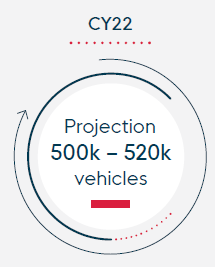


CY – Calendar year FY – Financial year
The car rental industry has been the most heavily impacted by the COVID crisis. Recovery has been slow to return to pre-COVID levels, but momentum is expected to improve in the near term. As vaccination rollouts accelerated globally and travel restrictions were lifted, activity in local and international leisure, corporate and government travel improved.

United Kingdom
The UK economic position has deteriorated since FY2021 as increasing energy costs, higher interest rates, higher personal taxes and accelerating inflation are constraining consumer spending. In 2021, GDP grew by 7,5%4 and it is predicted to grow by 3,5%5 in 2022, with inflation having reached 9,4%6 in June 2022 but may ease over the remainder of 2022 and into 2023. The market is also experiencing wage inflation due to labour shortages; in the automotive industry, technician wage costs are under renewed pressure.
The UK new vehicle market has declined by 18,2% for the 12 months to 30 June 2022, with the passenger market declining by 18,4%7, the LCVs market declining by 18,0%7 and the heavy commercial vehicles market declining by 5,5%. Motus was well positioned and maintained its retail market share. Inventory supply constraints are expected to continue in the short term.
Australia
Global vehicle shortages, ongoing Russia-Ukraine conflict, recent floods, continuing lockdowns in China and strong domestic demand have combined to generate cost pressures resulting in significant price increases in fuel, food and other consumables. GDP growth is expected to be 4,25%8 for 2022 and 2,75%8 in 2023 as growth in consumer and government spending remains robust. Vaccination rate targets have been achieved across states and lockdowns are easing.
The Australian automotive industry remains a highly competitive environment. The market declined by 2,1%9 for the 12 months to 30 June 2022, with Motus maintaining its retail market share. The market was also constrained due to erratic vehicle supplies experienced by OEMs. Annual new vehicle sales amounted to 1 020 221 vehicles8 for the 12 months to 30 June 2022, compared to 1 041 931 vehicles8 in the comparative period.
Car parcs across our markets

| 1 | International Monetary Fund | World Economic Outlook, update July 2022. |
| 2 | naamsa | The Automotive Business Council. |
| 3 | Nedbank Group | Unaudited Interim Results 2022. |
| 4 | The Office for Budget Responsibility | Economic and fiscal outlook – March 2022. |
| 5 | Bank of England | Monetary Policy Report – August 2022. |
| 6 | The Office of National Statistics | Consumer price inflation, UK: June 2022. |
| 7 | The Society of Motor Manufacturers and Traders | Press release July 2022. |
| 8 | Australian Reserve Bank | Statement on Monetary Policy, May 2022. |
| 9 | Federal Chamber of Automotive Industries (fcai.com.au). |
Global and local sector trends
The automotive industry remains highly competitive with technological advances and increasingly empowered consumers making it imperative that we adapt our operating models to remain relevant to the needs of the digitised consumer.
There are four megatrends likely to change how the global automotive industry will look over the next few years - sustainability, changing customer behaviour, technological advances and the workforce of the future.
Supporting sustainability
Investments must be prioritised across the ESG spectrum to create sustainability of products and the value chain.
- The global shortage of semi-conductors has highlighted the need to build resilient supply chains that are competitive, sustainable and inclusive.
- Increasing societal and customer concerns regarding energy security, climate change and oil demand is driving ESG investment across the value chain and the development of public private partnerships to shape policies, regulations and infrastructure.
- Although the COVID-19 pandemic has had an unprecedented impact on global economic and financial stability, climate change is an even bigger challenge. The Intergovernmental Panel on Climate Change's 2021 report1 indicates that climate impacts are already more widespread and severe than expected and highlights the social challenges that heighten vulnerability to climate risks.
- The adoption of NEVs is expected to accelerate exponentially in developed markets, with the UK planning to ban ICE vehicle sales and the United States (US) targeting 50% NEV sales by 2030. South African vehicle manufacturers supplying global markets will need to adapt their strategies to meet the growing global demand for NEVs in the short to medium term. Given the unreliable power network and the high cost of NEVs, adoption of NEVs in South Africa is likely to lag behind developed markets, with hybrid vehicle models potentially being better positioned to bridge this gap.
- Monitoring legislative changes and their interpretation, together with understanding OEM responses, is vital to ensuring the Group has a deep understanding of changes required for compliance and its impact on the Group and the industry.
| 1 | The Intergovernmental Panel on Climate Change Working Group's report 'Climate Change 2021: the Physical Science Basis' released in August 2021. |
Changing customer behaviour and technological advances
Investments are being made to provide customised mobility solutions and experiences, and new engagement models to build deeper connections with customers.
- The ongoing evolution of customer shopping preferences has resulted in the transformation of business to digital, omni-channel and omnipresent offerings that enhance the customer experience as prospective buyers continue to demonstrate a preference for using multiple digital channels to source information. This has required investment in a variety of digital offerings that allow customers to access information on a variety of vehicles, parts and accessories (including aftermarket parts for out-of-warranty vehicles) and mobility services and VAPS at their convenience, while maintaining a complementary physical footprint where aspects of the buying process remain difficult to digitise.
- In South Africa, demand for non-premium vehicles has continued to grow. It is likely that activity in the entry level vehicle market will continue to increase as customers' preferences trend towards more affordable vehicles. Deeper understanding will be required to understand shifts in individual mobility patterns, driving new engagement and business models. Creating connected mobility will increase as the availability of data from connected vehicles increases.
- As dependency on digital systems intensifies, cybersecurity threats are growing in sophistication and aggressiveness. Attacks on large and strategic systems will carry consequences for societies and impact public trust. Effective data management is also critical to delivering more personalised and customised mobility experiences, and technology governance and policies need to be implemented to create and maintain trust in technology and the opportunity that digital solutions present.
The workforce of the future
Investments must be made in new ways to attract, retain and reskill the workforce across the value chain
- With the ongoing disruption in the automotive industry, the workforce of the future will need to be appropriately skilled and adapt to new ways of working to support the acceleration of innovation and competitiveness, and to optimise productivity. While operational roles such as vehicle technicians, store assistants and retail managers are still key, there is also a growing need for data and software scientists. In addition, employees want flexible and collaborative ways of working, which is also a deciding factor in "who to work for".
Management response
Motus is well-positioned for longer-term resilience and growth in the markets in which it operates.
Our immediate responses include:
- Adapting to the changing conditions by optimising our footprint.
- Selectively investing in key regions and entering into strategic partnerships.
- Scaling our business activities accordingly and responsibly, introducing multi-franchise dealership models where appropriate.
- Maintaining good relationships with OEMs, suppliers and customers.
- Controlling capital expenditure.
- Driving innovation and improving technological solutions by upgrading IT systems, improving system accessibility and deploying IT solutions to leverage big data.
- Maintaining open and transparent communication with funders and investors, board and employees.
- Adapting and transforming ways of work to be future fit, including enhancing employee wellness programmes.
Detailed information
 Read more about the impact of global and local industry trends on our
business in our ESG report online.