


Employment equity
What we are doing
Our talent pipeline programmes provide a pool of entry-level candidates from designated groups from which we can fill posts when they become available. These candidates are upskilled through our accredited technical training programmes and formal learnerships. We continue to maintain an appointment, promotion and training ratio of 70:30 in favour of employees from designated groups.
 Leadership and people capabilities
Changes to our Employment Equity Plan
In the first two years of our approved five-year Employment Equity Plan ending in F2023, we made good progress in improving representation across our employment bands, in terms of race and gender. The restructure and cost containment measures undertaken in F2020 to respond to the COVID-19 crisis unfortunately impacted our ability to meet our F2023 employment equity targets. We received approval from the DoEL to review our Employment Equity Plan and recalibrate our targets taking into consideration our reduced workforce and the limited ability to appoint new employees in a subdued growth environment.
Our revised plan for the next three years has shifted from measuring black (African, Coloured and Indian) representation per employment band to aligning our workforce to South Africa's economically active population (EAP). Specific targets have been set for African men and women in top, senior and middle management positions. The revised plan was developed in a robust process together with all the CEOs of each business segment and workplace analyses were conducted to identify any remaining barriers to employment equity. The revised targets are very aspirational given the current low-growth environment and our opportunities to transform will result out of attrition. Each business segment is developing plans and monitoring systems to ensure these targets are integrated into the recruitment process and are monitored against interim annual targets. The revised Employment Equity Plan was submitted to the DoEL in December 2020.
Our new targets for June 2023 are:
- Senior and middle management: reflective of 50% EAP of African men and women. This equates to 21% of senior and middle management comprising African men and 18% African women.
- Junior management: reflective of 60% EAP of African men and women. This equates to 26% of junior management comprising African men and 22% African women.

Stakeholder engagement
The Employment Equity Amendment Bill was tabled in Parliament on 21 July 2020, and will drive sectoral targets for designated groups. In February 2021, the DoEL invited members and representatives of the RMI to attend a consultation session to engage on what this will mean for the automotive industry, and secondly, to determine the process of setting employment equity targets for the wholesale and retail trade and the repair of motor vehicles and motorcycles sectors.
Given that the RMI is required to consult its membership on the target setting process, it has proposed a joint task team be established together with the DoEL to:
- Interrogate the demographic data set provided by the Department and the data held by the RMI as an employer organisation to acquire a robust view of the industry composition; and
- Agree the process for RMI to consult with its members to prepare a consolidated submission of achievable and realistic targets for the industry sectors.
This proposal was submitted on April 2021, and the RMI is awaiting comment from the DoEL on the proposed targets. The RMI is committed to meaningful consultation with the DoEL to ensure effective industry transformation while maintaining high levels of regulatory compliance. Motus' targets are higher than those recommended by the DoEL.
Clear, co-ordinated and targeted interventions are used to source, develop and promote black candidates for management positions and to achieve race, gender, persons with disability and skills development targets.

Black representation
Hires and promotions
Of the 3 395 people hired in F2021,
Of the 169 employees promoted in F2021,
Training
training spend (3,2% of payroll costs) -
above the 1% required by the Skills Development
Act, and below the 3,5% required by the dtic.
was used to develop black people
(F2020: 71%) and 14% to develop
black women (F2020: 18%)
1 South Africa’s National Qualifications Framework (NQF) level 5.
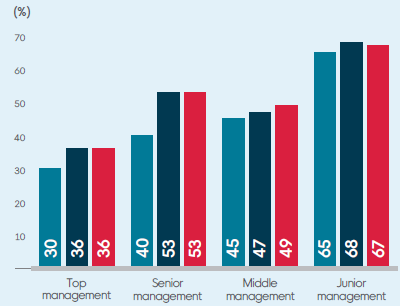
- 73% of the workforce is black. Good progress was made in improving year-on-year black representation at all management levels. Employment equity targets were met at all levels, other than middle management and the unskilled employment level, which were both marginally missed.
- 42% of Dealer Principals are black (F2020: 39%).
- We appointed 72 black managers across various businesses, with 41 being internal promotions.
- Changes to the Employment Equity Plan were made in consultation with our business segment employment equity forums.
- Objective: have a South African workforce that is reflective of South Africa's EAP by 2028.
Learnerships
- Hyundai onboarded eight candidates living with disabilities on a 12-month business administration learnership.
- Auto Pedigree offered a sales learnership for four learners living with disabilities. The learners have completed a generic management qualification (NQF15) and have progressed to NQF level 6.
- Europcar and Tempest offered a 12-month IT qualification (NQF 4), providing learners with IT support personnel skills. Of the 25 learners, 20 have found permanent jobs outside of Motus.
- Europcar and Tempest offered a 12-month business administration qualification (NQF 4), teaching effective communication and customer service skills in the workplace. All 15 learners have been employed by the Car Rental division. Both businesses also offered a 12-month business administration qualification (NQF 2) for learners living with a disability, which was launched in May 2021.
- Car Rental will launch a business administration learnership (NQF 4) for 20 unemployed learners in F2022.