


Building our portfolio of future-ready skills
A top priority for the Group is to develop and train our 17 283 employees so that they are knowledgeable and empowered to deliver our growth ambitions. Learning and development is also vital to their growth and development, and positively contributes to a more efficient, competitive and engaged workforce.
Digitisation is impacting skills and job roles. The future workforce will need to be change resilient. Employees will need commercial astuteness, an increasing set of new skills and the ability to collaborate more to navigate increasingly integrated organisations. They will have to understand the digitally savvy customer and be able to educate the traditional customer. Our learning and development approach must therefore also become more agile to ensure organisational success.
For Motus this means we must understand our reskilling needs and ensure that our workforce has the capability and digital IQ to support a future-fit organisation across multiple platforms (digital dexterity1 ). Big data and analytics, coding, design thinking, creative thinking, problem-solving and social platform sales and services skills are increasingly needed in the experiential workplace. Key is the digital capability of our sales teams; however, as dealerships evolve digitally, human interaction will still be critical at certain points to foster trust, knowledge transfer and other value-added services as well as deliver an enhanced customer experience.
1 Defined by Gartner as the ambition and ability to use technology for better business outcomes.
Our key focus areas
- Determine the new future-ready skills, competencies and attributes to be adopted by leaders and employees with a strong emphasis on digital skills and customer centricity.
- Rebalance and develop the necessary skills using various approaches.
- Availability of skills and expertise to drive strategic objectives, particularly digital and financial expertise, exacerbated by an international trend to recruit South African professionals willing to work remotely and who are paid in global currencies, impacting our ability to compete.
- In the UK and Australia, labour shortages, particularly for vehicle technicians, resulting in wage inflation.
What we are doing
Training and development opportunities
Tailored training and development opportunities are delivered at all employee levels. In addition to achieving our strategic objectives, our programmes support the achievement of our DEI targets and ensure a pipeline of skilled people for appointment to critical positions when they become available. In South Africa, each business segment manages its own technical and product-specific training, and the Group delivers non-technical training programmes.
Our Group-led programmes range from generic programmes that help employees deal with increasing uncertainty and complexity, to leadership and management programmes that focus on driving our desired leadership behaviours.
We use a blended approach to learning and development, including formal programmes, self-paced online learning, informal peer-to-peer interventions, webinars and on-the-job learning with assignments.
In the UK, all our employees have access to online learning and a wide range of apprenticeship opportunities are also available.
As more training shifts to online learning, our learning management costs have reduced; however, the number of hours of learning and development have steadily increased over the past two years, indicating good uptake of our learning programmes. Where learning is of a practical nature in-person training remains critical.
Digital astuteness
As the business model becomes increasingly digital and the technological component of most jobs grows, it is incumbent on the Group to build the digital dexterity of our employees. Programmes are needed to upskill lower skilled employees to ensure they are able to adapt to new ways of working, supporting their continued employment and enhancing their prospects of securing quality jobs. Our Digital Enablement Programme in South Africa teaches employees how to confidently navigate digitisation and use it to work more productively and effectively.
How we measure our performance
Our performance development approach ensures that employees receive the right training to help them meet their responsibilities and advance their careers. Individual employee development plans and training are tracked on the performance development system. Training spend and hours of training for South Africa are independently assured once a year. In addition, workplace skills plans and the Annual Training Report are submitted annually to the relevant SETAs1 in South Africa.
 Governance of social impact: governance approaches.
1 Sector Education and Training Authorities.
2022 performance and key objectives
South Africa
- Training spend of R166,3 million equated to 3,4% of payroll - exceeding the Skills Development Act's requirement that training spend equal 1% of payroll (2021: R143,9 million; 3,2%).
- In line with our priorities to develop leadership capability and prepare middle managers for future opportunities, 72% of employees at middle management level attended a training programme. At the semi-skilled level, 75% of employees received training as part of our commitment to uplift our employees.
- We developed the Digitally Speaking Programme to create a shared understanding of the business and social needs for digital dexterity. The programme also develops digital competencies and will contribute towards creating an effective digital and innovative culture. It covers topics such as how the automotive industry is changing, how digital makes jobs easier, and provides overviews of data analytics, artificial intelligence, the internet of things, 3D printing, cloud computing and cybersecurity, among others.
Training spend
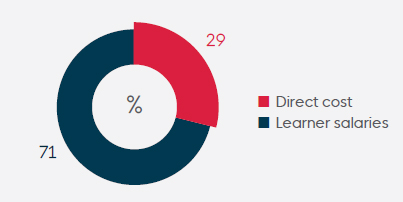
Training spend by type
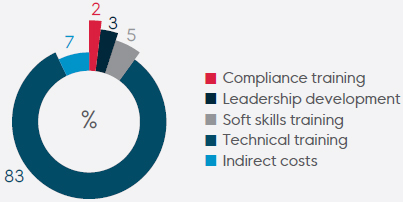
Training spend by category
Number of employees trained
Hours of training
Management development
Regions
- Total training spend in the UK amounted to R122,3 million (2021: R123,0 million) and in Australia to R1,4 million (2021: R4 million). The combined training spend equates to 3,2% of the total payroll costs for the two operations (2021: 5,5%). Training in Australia was severely hampered by COVID-19 lockdown restrictions.
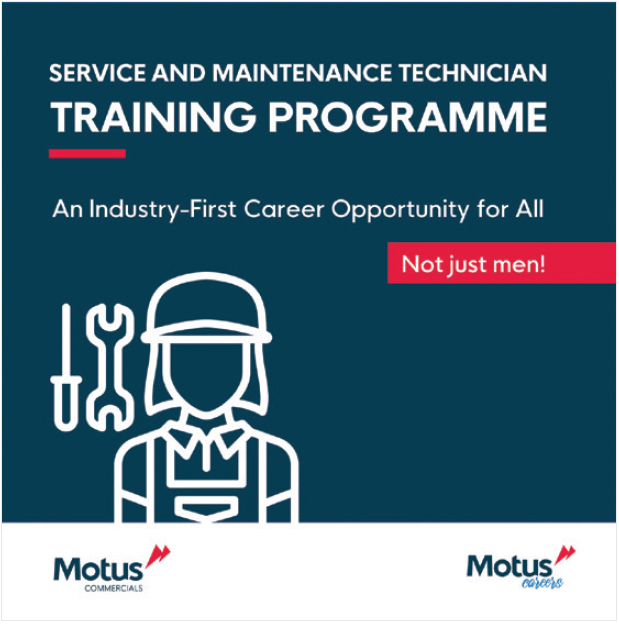
- In the UK, we launched the two-year Service and Maintenance Technician Programme to attract new talent into our workshops. Participants receive on-the-job training and a Level 1 Commercial Vehicle Technician status upon successful completion as well as the opportunity to study further. The commercial vehicles division also launched 70 apprenticeship vacancies, targeting young people (particularly school leavers) and women with positions in administration, sales, technical and customer services.
- We recruited around 30 technicians from South Africa to work in the UK, providing them with a three-year visa to work and gain international experience. The diverse group of technicians were recruited from both within Motus and the general market.
Training in the UK
Objectives
- Group: continue to identify current and future critical skills and develop customised training solutions to build these skills internally.
- South Africa: review our development programmes for their continued efficacy and introduce new programmes, where necessary, to build leadership, digital dexterity and other behavioural and attitudinal skills. A working group of representatives from across the operation will conduct the review.
- UK: increase the technician to apprentice ratio.