


New energy vehicles
Many automotive manufacturers have made commitments to significantly reduce or altogether halt the production of internal combustion engine (ICE) vehicles in the next 10 to 15 years. As such, it is estimated that plug-in EVs will account for about 70% of the global passenger vehicle sales mix by 2040 with a corresponding drop in ICE vehicle sales1.
NEV sales have been particularly strong in key markets around the world over the past year; although it should be noted that semi-conductors when available are prioritised for NEVs which require around twice as many chips as equivalent conventional vehicles, pushing up the number of NEVs in the market and possibly creating some distortion. Overall, this trend is expected to continue however the strong rebound in global vehicle sales over the next two years includes the sale of ICE vehicles despite an increase in NEV market share2.
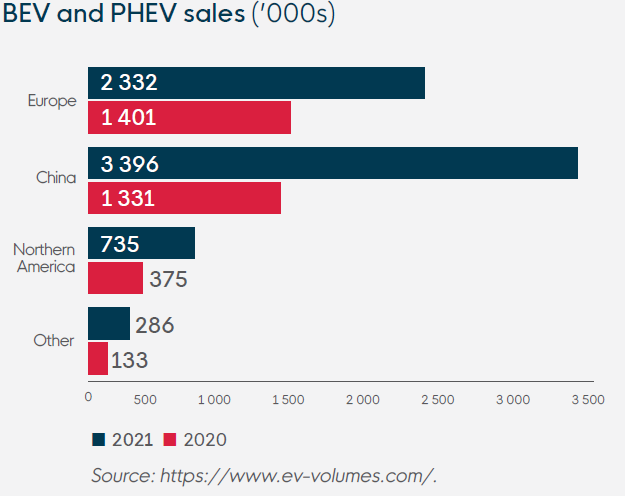
According to EV-volumes.com3, the global sale of plug-in EVs reached 6,75 million units in calendar year (CY) 2021, 108% more than in CY2020. This includes passenger and commercial vehicles and light trucks. The global market share of plug-in EVs grew to 8,3% from 4,2% in CY2020, with BEVs representing 71% of total plug-in EV sales.
BloombergNEF's Electric Vehicle Outlook 2022 reports that there are now almost 20 million passenger plug-in EVs, over 1,3 million commercial plug-in EVs (including buses, delivery vans and trucks) and over 280 million electric mopeds, scooters, motorcycles and three-wheelers on the road globally. Passenger plug-in EV sales are set to continue rising sharply in the years ahead, with sales projected to rise from 6,6 million in CY2021 to 20,6 million in 2025, mostly due to adoption in China. In markets such as Germany, the UK and France, the plug-in EV share of sales is likely to be as high as 40% to 50% in 2025. China and Europe together will account for almost 80% of global plug-in EV sales in 2025.
The acceleration in NEV adoption means that ICE vehicle sales peaked globally in CY2017 and are now in permanent decline. By 2025, passenger ICE sales are likely to be 19% below their CY2017 peak. The global fleet of ICE should start to decline in 20244.
Many governments such as the UK, Germany, France, Spain and New Zealand are offering incentive schemes to bring down the cost of NEVs and boost demand supported by policy changes that favour NEVs. Such policies have been in place in Europe and China for a while now, with the USA adopting a similar policy under President Biden. The number of available charging stations has also increasedsharply in recent years, with the aid of government funding, surpassing one million charging points globally in CY20205 – more than double the number three years ago. Most of this steep increase was in China.

| 1 | Source: https://www.moneyweb.co.za/news/industry/evs-to-account-for-70-of-global-passenger-vehicle-sales-by-2040-sa-must-keep-up/ |
| 2 | Source: Nedbank CIB PMG sector (October 2021). |
| 3 | Source: https://www.ev-volumes.com/. |
| 4 | Source: https://about.bnef.com/electric-vehicle-outlook/ |
| 5 | Source: https://www.bloomberg.com/news/articles/2020-08-05/global-ev-charging-points-hit-1-million-threshold#xj4y7vzkg. |
Over the longer term, a move to hydrogen-powered vehicles is a likely solution as this is a more emissions friendly option that removes the concerns around lithium-ion battery waste disposal.
NEV sales in the South Africa
The premium passenger vehicle market will lead the e-mobility revolution globally and in South Africa. We expect an array of premium BEVs, around 20 models, to enter the South African market in CY2023, a fairly significant increase from the six models that were available in CY2021.
South Africa does not have a formal government policy position or adoption target for the production or sale of NEVs. To increase the pace of adoption national legislation must be amended, new models introduced, local production increased, charging options introduced and consumer awareness enhanced. However, even if these changes are made, in the absence of government price subsidies, the affordability of NEVs will remain the most critical factor for financially strapped South Africans.
The key constraints that limit the adoption and local production of NEVs include:
- Taxation: NEVs are still heavily taxed owing to outdated legislation, carrying a 25% import tax compared to the 18% import tax for ICE vehicles from Europe. It is expected that the government will review import tariffs, sales incentives and tax credits to enhance the attractiveness of these vehicles for consumers and manufacturers.
- Power supply: South Africa’s constrained and intermittent power supply make BEVs in particular a risk as the primary mode of transport. Yet, as consumers invest in solutions to reduce their exposure to load shedding, domestic demand for lithium-ion batteries and energy storage has risen and is expected to continue to grow by more than 7,5% from 2020 to 2025.
- Affordability: nearly all BEVs currently available in South Africa are premium brands. Enhanced technology may lower manufacturing costs in time; however, this is not certain. The current average finance amount for vehicles is R350 000, with most NEVs today costing upwards of R660 0001.
- Practicality: NEVs are most efficient at lower speeds and in stop-start driving conditions, with the optimal operating temperature for NEV batteries being 21,5 degrees Celsius. The long distances travelled in South Africa and at higher speeds means that these vehicles operate less efficiently than ICE vehicles and have a limited travel range (although driving ranges on some models have improved to more than 400 kilometres). In addition, the lack of charging infrastructure makes a long-distance route with a BEV somewhat impractical.
- NEV batteries: NEV batteries on average are guaranteed for eight years or 160 000 kilometres; however, the replacement cost is between R20 000 and R100 000 depending on whether the battery pack is rebuilt or replaced. This is a large expense in the vehicle ownership cycle; however, battery technology is evolving at a fast pace with new chemistries and formulations, and battery prices have declined in the past couple of years due to economies of scale.

| Note: fuel was calculated at R20,45 a litre and electricity at R2 per kilowatt hour |
The above graph shows that the BEV model is 103% more expensive than the ICE equivalent to buy but only 38% more expensive in terms of the total cost of ownership. The hybrid model is 26% more expensive than the ICE equivalent to buy and 1% less expensive in terms of total cost of ownership. At higher fuel prices, the total cost of ownership of the BEV and hybrid becomes more attractive compared to that of the ICE model, even if electricity prices also increase. With no government subsidies, the hybrid model is the most competitive option to gain NEV market share in South Africa.
At July 2022, 1 796 NEVs had been produced locally year to date, 82% being MHEVs and the balance PHEVs. Total imports for the same period were 888, with 27% being BEVs, 11% being PHEVs and 551 being MHEVs2. We estimate that the market potential in South Africa is around 43% for MHEVs, 21% for PHEVs and 7% for BEVs. While MHEVs do not cultivate the habit of plug-in charging and are not viewed as a long-term solution, it makes sense for South Africa to push MHEVs until a government incentive structure is in place to stimulate consumer demand for plug-in EVs. However, investment in this technology will dry up over the next few years as the world switches to plug-in solutions.
| 1 | https://www.engineeringnews.co.za/article/ev-revolution-to-be-felt-in-sa-in-2022-but-affordability-concerns-linger-2021-10-29. |
| 2 | naamsa August new vehicle sales: for the period January to July 2022. |
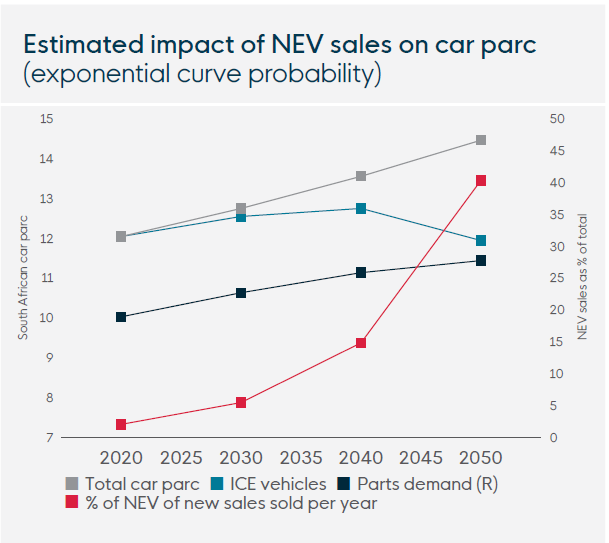
We believe that true adoption, where a NEV is the first choice for a vehicle buyer in South Africa, is likely to occur around 2030, when technology improvements potentially lower the prices of mid-market models so that they are more affordable.
| Source: Motus Aftermarket Parts (management estimate). |
Our retail representation of premium brands such as BMW, Mercedes, Audi and Jaguar Land Rover enables us to learn from the developments in this market and places Motus at an advantage to capture the NEV market in South Africa when demand increases. In addition, our importer brands Kia, Hyundai and Renault are leading BEV sales in Europe. In the European Car of the year 2022 Awards, the Kia EV6 won Car of the Year with 279 points, the Renault Mégane E-TECH Electric was placed second with 265 points and third place went to the Hyundai IONIQ 5 with 261 points. The Mitsubishi Outlander PHEV recently won the global iF Design Award 2022.
BEVs have less-complex engines that do not require oil changes and have fewer mechanical parts to replace and service. This will be offset by accelerated wear and tear given the increased weight of BEVs, creating opportunities to expand our aftermarket parts product range over time to include suspension, steering and other components for these vehicles, and higher value replacement parts in terms of sensors, vehicle management and batteries. Hybrids on the other hand require additional parts as well as the servicing of both their internal combustion and electric engines, increasing the scope of labour. Some investment may be needed to train dealership personnel and technicians (also provided by OEMs), and to build charging stations and fit workshops with new tools and monitoring machinery.
Other opportunities that exist for Motus in this space include new mobility offerings related to NEVs, using the Car Rental fleet to introduce drivers to NEVs, battery recycling and refurbishment, and the provision of national charging infrastructure that uses renewable energy.
In June 2021, the UK announced that it would provide R3,7 million in funding for new skills development across South Africa for jobs in the NEV sector. The funding will ensure students develop highly sought-after skills that will help South Africa transition to a lower carbon economy. Online NEV training content and support for lecturers will also be funded. In addition, the British High Commission has teamed up with South Africa’s Department of Science and Innovation to develop a report on the type of skills and training needed for a green hydrogen future, and how these can be made accessible. This bodes well for advancing South Africa’s progress towards adopting this new technology.
NEV sales in our other regions of operation
United Kingdom
The tax perks in the UK, together with the savings gained from fewer petrol purchases, balance the higher price of NEVs, making them economically viable for consumers. In CY2021, slightly less than 191 0001 BEVs were registered, more than the sales for the previous five years combined and accounting for 12% 2 of all new vehicle sales in the country. Together with just under 115 000 PHEVs sold this means that 18,5% of new vehicles registered in CY2021 can be plugged in. This is in addition to the 147 000 MHEVs registered. Around 27% of the vehicle market in the UK is now electrified in some form.
Around 45% of our passenger and light commercial vehicles businesses in the UK are providing NEV solutions. Within Pentagon Motor Group alone we handle passenger NEVs from 10 automotive manufacturers across 28 franchise locations. NEVs are emerging more slowly however in our heavy goods vehicle businesses. Bearing in mind that our passenger vehicle business, where plug-in EV sales are more prominent, is a smaller component of the UK operation, in 2022, around 9% of our new vehicle sales were plug-in EVs (2021: 5%). This equates to 2 014 vehicles sold. Our plug-in EV market share in the UK is around 0,4%.
While the UK government plans to ban the sale of ICE vehicles by 2030, a shortage of on-street chargers remains a challenge.
| 1 | https://media.smmt.co.uk/december-2021-new-car-registrations/. |
| 2 | https://heycar.co.uk/blog/electric-cars-statistics-and-projections. |
In London, where air pollution is a major public health emergency, the electrification of city fleets is a key opportunity. Our light commercial vehicles division supplied 11 electric tippers to Nottingham City Council in 2021, the first order of this kind for our body conversion division. A further 10 plug-in EVs of various types were converted for customers in 2022.
Australia
At April 2022, there were 30 NEV models available in Australia, including 65 variants, compromising of 28 PHEVs and 37 BEVs. Since CY2011, more than 40 000 NEVs have been sold in Australia1 . In CY2021, NEVs accounted for 8,6% (over 23 000 registrations; CY2020: 7,1%) of total new vehicle sales, in line with the United States but lagging when compared to Europe and China. BEVs recorded the strongest growth. Year-on-year growth of NEV sales on the continent show a slow trend in adoption, with some of the same constraints faced in South Africa, particularly those related to distances travelled. However, adoption has also been impacted by the knock-on effects of lockdowns in China early in CY2022, which halted production and disrupted the supply of components. According to BloombergNEF, 18% of new vehicles in Australia will be electrified by 2030, rapidly increasing to 64% in 2040.
The election of the climate-focused Labour Party should increase government support for NEV models. In November 2021, a package of R2,0 billion (AU$178 million) was announced to give momentum to the roll out of hydrogen refuelling and plug-in EV charging stations. Together with various state-level subsidies, such as the rebate on the first 25 000 plug-in EVs purchased in New South Wales (NSW), this should boost sales. At the end of CY2021, there were 10 026 BEVs registered in NSW, with about 61% being Tesla2.
Automotive manufacturer initiatives
Among our importer brands, Hyundai’s IONIQ 5 paves the way for its electrification strategy, which is a target of 7% of the global BEV market by 2030, equating to 1,87 million BEVs sold annually by 20303. Kia is aiming for annual sales of 1,2 million BEVs by 20304. The Renault-Nissan-Mitsubishi Alliance has defined a common 2030 roadmap on BEVs and the Alliance aims to become carbon neutral by 2050. In addition to the Alliance’s strategy to introduce 35 NEV models on five common platforms (currently 10 models on four platforms), there is also a battery strategy to reduce costs by up to 65% by 2028 while also increasing driving distances 5. The Renault Group aims to electrify all new passenger vehicle models by 2025, and the Mitsubishi Motor Corporation has a target to have 50% of its vehicle production being NEVs by 2030.

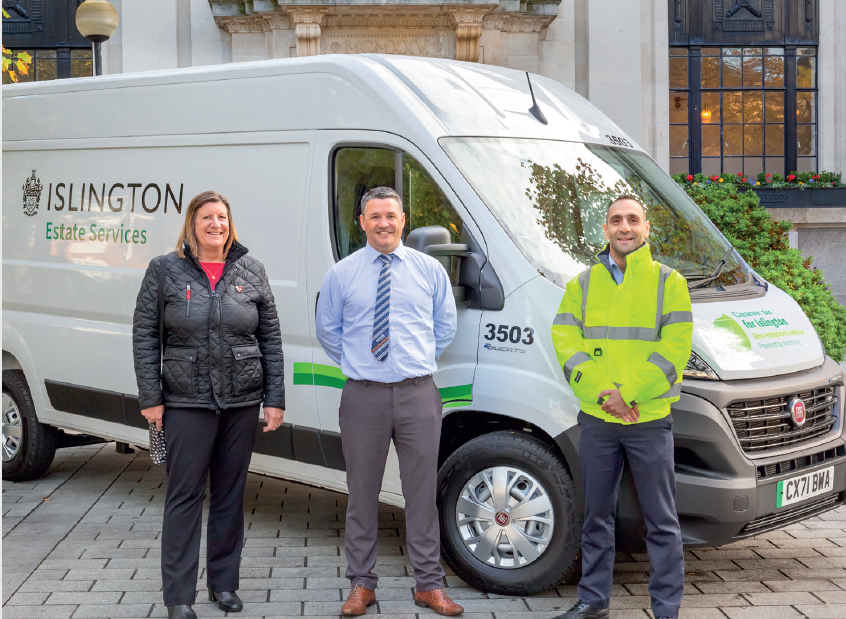
The UK’s first
E-Ducato electric
vehicle supplied
by Motus’ light
commercial
vehicles division.
German automotive manufacturer Audi is one of the key competitors that have entered the South African market with the launch of its all-electric e-tron model range in CY2022 (comprising six different e-tron derivatives). The Audi e-tron 55 SUV is the most affordable of the range, starting at just under R2 million. The vehicle has a range of 369 kilometres to 440 kilometres.
In October 2021, Toyota launched its Corolla Cross hybrid range in South Africa, the first locally produced MHEV. Currently the demand for the Corolla Cross is over 50% of total production. Toyota plans to introduce MHEV versions of all its models in South Africa with hybrid derivatives already available for the Corolla sedan, RAV and all Lexus models.
Many OEMs have made a commitment to greening their supply chains and being carbon neutral. For example, Kia’s vision is to become a truly sustainable, responsible and innovative solutions leader, and has committed to carbon neutrality by 2045. The Renault Group has a clear action plan to achieve carbon neutrality in Europe by 2040 and worldwide by 2050. The Renault Group’s Re-Factory in Flins (France) and Seville (Spain) are dedicated to the circular economy and open to start-ups and partnerships. The factories are structured around four areas of activity; the reconditioning of used vehicles, repairing and developing applications for batteries, recycling of parts, and training, research and development relating to the circular economy.

| 1 | naamsa I The Automotive Business Council (at May 2022) |
| 2 | naamsa I The Automotive Business Council. |
What we are doing
OEM transition shifts
As an importer and dealer representative of automotive manufacturer products, we have limited influence on NEV production. We keep abreast of the shifts that our OEM partners are making in their transition to BEVs and hybrid vehicles, so that when policy changes are implemented in one of our regions of operation, we are able to quickly add these types of vehicles to our portfolio.
Policy development
The automotive industry accounts for 17,3% of South Africa’s manufacturing output with vehicles and components exported to 152 international markets. The manufacturing segment of the industry employs around 110 000 people across its various tiers of activity 1 . In CY2020, three out of every four vehicles manufactured in South Africa were exported to Europe and the UK, and as of the first half of CY2021, four out of five were exported. By 2030, around 40% of all new vehicle sales in Europe are forecast to be NEVs, increasing to 80% in 2040 2. Many European territories are setting aggressive NEV adoption targets and the discontinuance of ICE vehicles.
To protect the local auto manufacturing base and export sales volumes, and position South Africa as a strategic manufacturer and exporter of NEVs to Europe, the Americas and the wider African continent, government must develop policies to enable OEM's to accelerate progress in NEV production. The scale of the challenge is massive and requires a co-ordinated approach and honest conversations between business and government to shape policies, regulations and incentives, and build the infrastructure needed.
We participate in a number of naamsa | The Automotive Business Council (naamsa) committees, including the fuel committee, to ensure we keep abreast of and contribute to policy development. Through naamsa we engage with the Department of Trade, Industry and Competition (dtic) on incorporating global NEV developments in the Automotive Masterplan which aims to further develop the South African automotive value chain through to 2035. We have provided feedback through naamsa to the dtic on its draft New Energy Vehicle Green Paper, the first step towards establishing a clear policy on enhancing South Africa’s competitiveness in the transition to cleaner fuel technologies and sustainable manufacturing processes. naamsa working together with government will facilitate a NEV cost-benefit study to be completed before the end of December 2022.