


Developing a compelling employee value proposition
Key for Motus is to provide a compelling EVP to retain and attract exceptional people and position the Group as an employer of choice within the automotive industry. This area of our people strategy is work in progress, and work is underway to define the Motus EVP.
Hybrid workforce model
The nature of our business requires that the majority of our workforce (dealership personnel and technicians) work on-site with very limited opportunity for remote working. Hybrid working arrangements provide some benefits in terms of flexibility for employees, and lower costs and the ability to attract talent for organisations; however, they also present challenges, with some companies reporting deteriorating employee wellbeing, longer hours worked, distractions in the home environment and feelings of isolation, among others. Within the Group, the implementation of hybrid working is at the discretion of our business segments, which have been tasked with formalising their work-from-home approaches according to their needs.
Our key focus areas
- Identify our key EVP attributes and effectively communicate them and showcase available career paths and opportunities for talent within the Group.
- Selectively compete and differentiate pay for talented individuals with the skills needed for the future.
- Provide holistic wellbeing offerings (see
 Supporting the wellbeing of our people).
 - Ensure effective and quality leadership skills that lead the workforce in a consistent manner.
Information management systems
HR information management systems play a role in delivering a great employee experience as they free up HR teams to focus on strategic human capital management planning and enhance communication with employees. Our central HR database in South Africa consolidates all HR data and administration and reporting processes. Strict access control protocols apply and users of the system are trained.
Performance management
Our performance development approach drives better engagement between employees and their line managers, aligning employee standards of performance and expectations with strategic business objectives, and ensuring that employees are assessed fairly, developed appropriately and rewarded and recognised for exceptional performance. It also identifies corrective development or supportive actions to manage poor performance. Employees are assessed on their performance and values-based behaviour.
Fair remuneration
When necessary, we adjust roles and remuneration according to level of complexity, decision-making and skills required. This process enables us to empirically demonstrate the value of roles and jobs in relation to one another, regardless of the incumbent, and to defend our pay philosophy.
As part of the annual employment equity reporting cycle in South Africa, we assess the remuneration gap between the highest paid and lowest paid employees and at the same time identify if there are inequalities in remuneration in relation to race and gender in the various occupational levels. In the UK, we issued a report on the gender pay gap in 2022 and are taking steps to address gender pay equity.
Employee representatives
Our employees are free to choose which union they wish to be affiliated with. In South Africa, engagement with unions takes place on a needs basis and occurs at business segment level. Non-unionised employees are always represented in major discussions.
Retrenchments are a last resort, and voluntary retrenchments and early retirement options are always exercised first. Where roles become redundant, we look to reassign employees into different roles and/or locations supported with retraining, where required. Retrenchment processes are undertaken in compliance with all applicable regulation, and with close engagement with unions.
There is no material union activity in the UK and Australia.
Dispute and grievance management
All South African managers and supervisors attend a two-day labour relations course to equip them to manage industrial relations-related matters and disciplinary cases fairly, and to apply the requirements of the Basic Conditions of Employment and Labour Relations Acts. Employee relations in South Africa are tracked and monitored monthly, including disciplinary hearings, dismissals, poor work performance, Commission for Conciliation, Mediation and Arbitration (CCMA) and labour cases and tip offs, among others.
2022 performance and key objectives
Group
- There were no incidents of non-compliance with labour-related regulations and/or voluntary codes.
South Africa
Information management systems
- We continue to develop a single credible source of employee data. During the year, the stability of our HR platforms was improved, more robust processes established and datasets enriched and validated. Improvements were made to payroll and the synchronisation of employment equity, training and industrial relations datasets. Looking forward, focus will be placed on roles and organisational structures.
- An updated job portal for available positions was relaunched.
- Retail and Rental's new employee management system aims to create professional, paperless and consistent approaches for recruitment, appointment, onboarding, transfer and induction processes, benefitting job applicants, new appointees, line managers and HR practitioners. It is also redesigning its eLearning system.
Dispute and grievance management
- 1 033 employee relations matters were heard, a 162% decrease compared to 2021. In 2021, the number of matters heard was understandably high given the COVID-19 related retrenchments.
- Disciplinary hearings remained high at 531 matters, of which 299 resulted in dismissals. 26% of dismissals related to not following Motus' work standards, 19% for insubordination and 27% for dishonesty.
Industrial relations
- The motor industry's wage agreement between organised labour and the Motor Industry Bargaining Council (MIBCO) is valid to August 2022. The MIBCO wage agreement for the next three years is under negotiation.
Union memberships
7 746
employees are covered by collective bargaining agreements with the National Union of Metalworkers of South Africa (NUMSA) and the Motor Industry Staff Association (MISA), representing 59% of our workforce (2021: 7 631). Some 89% of union membership is with MISA (2021: 88%)
Industrial relations training
276
employees received training on labour relations
(2021: 182)
Disputes and grievances
531
disciplinary hearings
(2021: 506)
49
poor work performance hearings
(2021: 210)
36
grievances lodged
(2021: 51)
87
of the cases referred to the Dispute Resolution Centre or CCMA were finalised
(2021: 114)
17
arbitration awards found in our favour were referred to the Labour Court (these take two to three years to finalise)
(2021: 27)
Regions
- In the UK, we are merging benefits (health insurance, life assurance and critical health cover) from separate entities into single accounts to improve the service costs for employees and streamline administration for the Group. We have also completed a project to bring all pension schemes into a single Group scheme.
- In the UK, additional functionality was added to the centralised HR system, which now covers payroll, annual leave, personal .development reviews and recruitment.
Objectives
- South Africa: as our core HR platform reaches end of life, discussions are underway to assess alternatives that can enhance the achievements we have made to date.
- UK: add an onboarding module to the HR system and introduce an eLearning system. The consolidation of the HR and payroll systems has achieved a cost saving of around R2 million (£100 000) per annum to date.
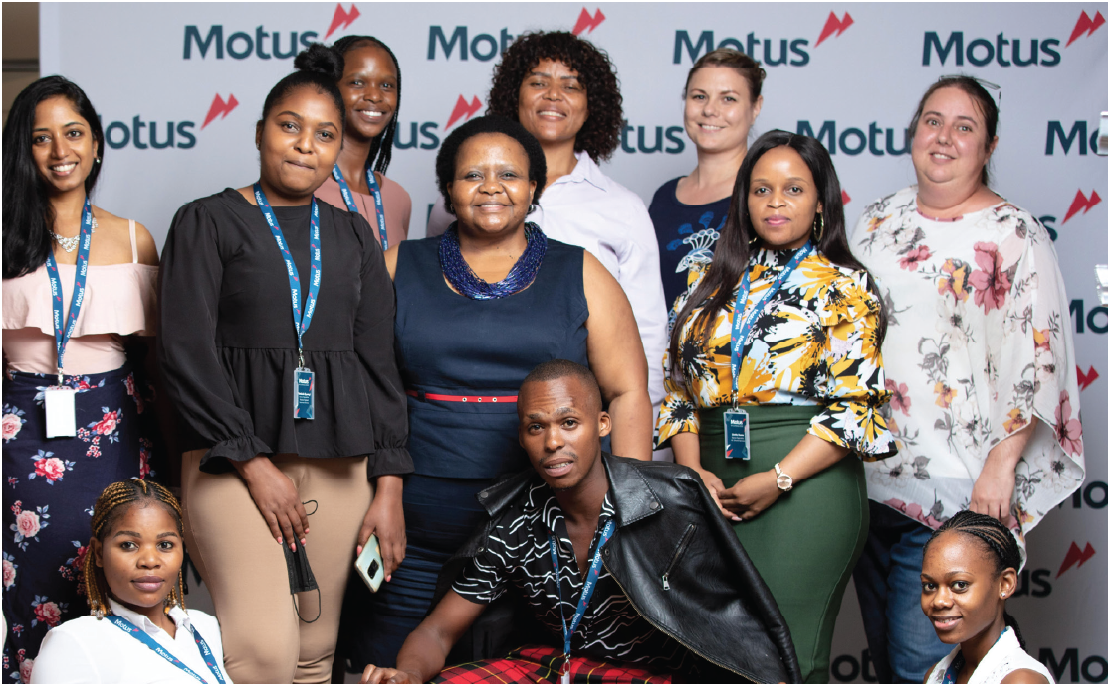
The ‘Thinking the Future’ HR conference provided a platform to align the Motus people strategy to business requirements and across business segments in South Africa.