



AND STRONG
INSTITUTIONS

FOR THE GOALS

 GOVERNANCE
Ethical and
compliant business
conduct report
Maintaining our moral compass
For Motus, integrity means always acting with honesty, fairness and transparency, conducting our business with diligence, and respecting each other, our customers, suppliers and other stakeholders, and the communities in which we operate.
Our Code of Ethics sets the standard of ethical conduct that is expected of all our employees. We strive to ensure that the way we behave, the decisions we make and the actions we take reflect our values; the foundation for our ethical culture. Our values require us to be fair, accountable and driven, and to ensure that we operate in an environmentally friendly and responsible manner. Together our ethical culture and our values enable us to explain our decision-making when held to account by our stakeholders.
Every employee is responsible for exercising good judgement and obtaining guidance on appropriate business conduct, when needed. Our Code of Ethics, leaders, standard operating systems and values guide them in this responsibility.
Our memberships in professional bodies and institutes require adherence to professional codes of conduct and they allow us to engage more broadly on key matters such as the detection, monitoring and elimination of corruption, fraud and criminal activities. Through the National Automobile Dealers Association (NADA) we have kept abreast of the Financial Intelligence Centre's (FIC) initiative to lessen criminal activity. We are a member of the Gordon Institute of Business Science Ethics and Governance Think Tank, which gives us access to thought leadership on ethics management.
Unethical behaviour is not tolerated. Decisive action is taken when matters relating to unbecoming conduct are brought to our attention. All fraudulent matters are reported to the relevant authorities.
Governance
Maintaining a moral compass in challenging times when a poor economic climate may lead to increased incidents of fraud, corruption and misconduct, including by managers and employees.

the truth
everywhere
for managers
- Create an environment where honesty and accountability flourish and compliance is a central focus.
- A commitment across the Group to maintain the highest ethical standards in all business dealings.
- Every employee representing or working for the Group is expected to follow the Code of Ethics at all times.
- All persons, including service providers, sub‑contractors and business partners, are required to act consistently with the Code of Ethics when acting on the Group's behalf.
- All managers have additional responsibilities to create an open environment in which employees feel comfortable to ask questions, raise concerns and report misconduct.
- Leaders with behavioural integrity are valued and promoted.
What we are doing
Training and awareness
Ethics and anti-fraud and corruption awareness and training, customised for each business segment and region, ensures that our people understand the behaviours we expect of them. Training covers the content and principles of our Code of Ethics and explains the types of incidents identified through the Motus whistle-blowing hotline.
Whistle-blowing hotline
Independent service providers manage our whistle-blowing hotline, which supports anonymous and confidential reporting by all stakeholders. Any concerns relating to unlawful, dishonest, disrespectful and environmentally unfriendly behaviour can be reported. All instances of alleged misconduct are taken seriously, and are investigated and resolved in line with our internal policies. Reports are closed only after having been discussed with the appropriate managers. This applies to tip-offs received through the whistle-blowing hotline, reported to management or received through any other compliance oversight channel.
 |
Additional informationHotline tel: 0800 666 005 Hotline email: motus@tip-offs.com |
Our employees in the United Kingdom (UK) have access to Safecall, which allows them to anonymously raise problems concerning top management. In Australia, the Speeki application (app) and website enable all employees to speak out anonymously. This reporting tool was introduced in 2021 and indications are that employees are comfortable to use it. In the Rest of Africa there is a dedicated email address for employees to report unethical behaviour. All emails are received by the operation's CEO.
Ethics Self Declaration Programme
Our Ethics Self Declaration Programme in South Africa is an annual online confirmation process where select employees self-declare any conflict of interest and their compliance with our policies and ethical standards. It applies to the Group's Code of Ethics, anti-bribery and corruption policy, conflicts of interest policy, supply chain code of conduct and policy statement on relationships in the workplace. It also allows these employees to raise any non-compliance matters they are aware of and ask for training on our policies. The programme applies to all Executive Committee members and their direct reports, and employees operating in business segments who have been identified as having to self-declare based on their roles, for example, all employees in our financial service provider (FSP) businesses are covered by the programme. Annual self-declaration is mandatory for Group and business segment executives.
Declarations of conflicts of interest are reported at divisional meetings for our UK and Australian operations.
Ethical and responsible business conduct in the value chain
The majority of the products we sell are sourced directly from original equipment manufacturers (OEMs), with most of our supplier contracts being of a long term nature. We expect our suppliers to abide by the terms set out in our Code of Ethics and supply chain code of conduct, which states that Motus considers social, environmental and fair economic business principles as key elements in business award decisions both for new and existing suppliers. The regional operations adapt the Group's supply chain code of conduct to meet their own supplier requirements.
Suppliers are expected to comply with all laws and regulations that apply to them in all jurisdictions of operation, and when legislation is lower than the international standards outlined in our supply chain code of conduct, suppliers are required to adopt our higher standards. Our suppliers are also expected to prevent any contravention of human rights, ensure that there are no discriminatory practices in their organisations, employ practices that reduce health and safety risks as far as reasonably possible, and prevent or mitigate environmental impacts that their business activities may cause or contribute to, or which may be directly linked to their operations, products or services by their business relationships.
Aftermarket Parts' membership of Nexus enables it to buy directly from either MTS Systems Corporation (a global supplier of test systems and industrial position sensors) or ARCO Motor Industry (a professional engine parts exporter). Suppliers are audited in terms of their standards, specifications and processes. The Nexus vetting service is available to its members both for current and new suppliers. Vetting is aligned to European Union standards, and covers labour legislation, health and safety, and corruption.
We will not hesitate to terminate or re-negotiate agreements and relationships that contravene international human rights standards.
In South Africa, broad-based black economic empowerment (B-BBEE) status and/or contribution to enterprise and supplier development are additional criteria that are considered when selecting suppliers.
We reserve the right to audit supplier sites, whether by an internal team or through the use of a third party appointed by the Group to verify conformance to our requirements. Our assessment of our suppliers' ESG performance is limited.
Human rights
We adhere to the principles embodied in the Universal Declaration of Human Rights, the South African Constitution and the International Labour Organization's Declaration on Fundamental Principles and Rights at Work. In line with regulatory requirements, we provide an annual anti-modern day slavery statement on our website in the UK, and in Australia we report annually against the requirements of the Modern Day Slavery Act. Our human resources policies in each of these operations incorporate the necessary regulatory requirements as they relate to modern day slavery and human trafficking.
How we measure our performance
Internal audits cover risks relating to bribery and corruption, unethical business practices, human rights and ethical conduct awareness. All reports to the whistle-blowing hotline are monitored and investigated, including those relating to working conditions and the number of hours worked. Business segments and regions conduct their own employee engagement surveys; however, all surveys include a question on integrity and honesty, and the level of transparency within the operation. This allows us to understand how our employees view ethics and our ethical conduct. To date, no material concerns have been raised in these questions.
 Governance of ethics and compliance.
2022 performance and key objectives
Group
Conduct
- Internal audits did not identify any material concerns relating to bribery and corruption, unethical business practices or human rights risks.
- No public legal cases regarding corruption were brought against Motus, any of its operations or its employees during the reporting period.
- Two complaints were received from the Competition Commission for alleged anti-competitive practices in terms of the Guidelines for Competition in the South African Automotive Aftermarket (Automotive Aftermarket Guidelines). The Commission did not find any breach by Motus in either case.
- We updated our fraud prevention framework and enhanced our internal reporting to support one approach to fraud-related incidents, which will cover both the whistle-blowing hotline and our internal reporting systems (incidents reported to internal audit and management).
Whistle-blowing hotline
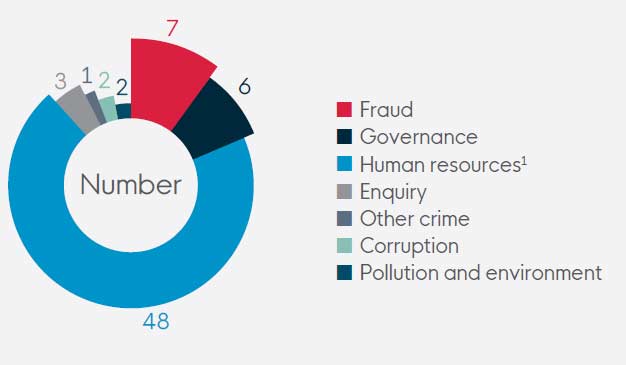
- 69 tip-offs were reported to the whistle-blowing hotline. At year-end, all reports had been investigated and closed. Of the reports received, 10 (2021: 19) were valid concerns where disciplinary or remedial action was taken. While our vigorous controls are identifying dishonest behaviour, leaving little room for misconduct within our businesses, residual risk remains, particularly in difficult economic times.
- 70% of the whistle-blowing reports related to human resources (HR) matters, with some reports being of a malicious nature and others being grievances. We are working to ensure we have a fair and balanced internal grievance process that serves as the first line of reporting for HR issues, to free up the whistle-blowing hotline for fraud detection.
- The two reports relating to corruption concerned bribery and corruption (supply chain) and extortion (internal). Neither case was found to be valid.
Ethical and responsible business conduct in the value chain
- We started a high level analysis of our non-OEM supplier sourcing processes per business segment. This included the appointment of a resource both at Group and business segment level to redefine our procurement strategy and how we monitor suppliers. We also launched a pilot programme to assist 10 small, micro and medium enterprises in South Africa to enhance their operations.
Number of reports through the ethics hotline
Stakeholders
- No contributions were made to political parties.
Training and awareness
- We have developed a new ethics training module, which includes case studies and guidelines on how to use the whistle-blowing hotline.
Ethics Self Declaration Programme
- The Ethics Self Declaration Programme was rolled out to all business segments. Of the 3 926 employees covered by the programme, 88% had completed self‑declarations by the end of the financial year. Completion among our executives, senior managers and FSPs was 100% . Additional awareness and training will be provided to the employee groups where completeness levels were below 85% . Online self-declaration has also been included in our induction programmes.
Ethical and responsible business conduct in the value chain
- Mobility Solutions, which has a national network of 3 800 suppliers, is standardising its procurement processes to realise a number of benefits, including enhancing its supplier relationship management, B-BBEE scorecard rating, early settlement process and compliance with the Automotive Aftermarket Guidelines in terms of supplier management. It will also improve the service levels received from suppliers and enable the business segment to take advantage of competitive pricing. The E-Procure system will be rolled out in 2023.
Stakeholders
- We have submitted comments on the draft amendments to the South African Automotive Industry Code of Conduct to the National Consumer Commission through naamsa | The Automotive Business Council (naamsa), the Retail Motor Industry Organisation and NADA.
Objectives
- Group: introduce a Group procurement framework with business segment applications in 2023.
- Group: align our regional operations with the ethics framework and practices used in South Africa post-2023.
- South Africa: develop a centralised gift register and conflicts of interest register linked to each employee's ID number by 2023.
- South Africa: roll out the Ethics Self Declaration Programme to 6 500 employees in 2023, achieve a 90% completion rate and ensure that no employee misses a declaration over a two-year period.
- South Africa: roll out the new ethics training module in 2023.