


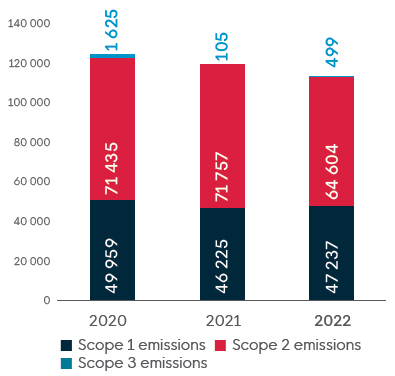
Carbon footprint (Group)
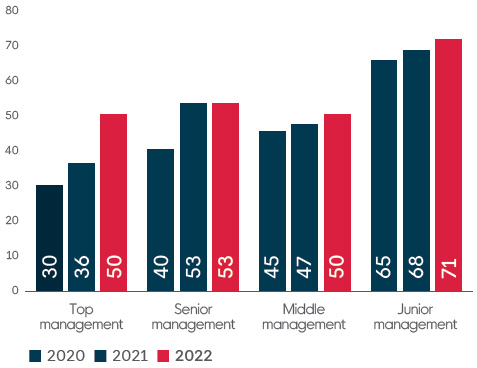
Black representation at management level (%) (South Africa)
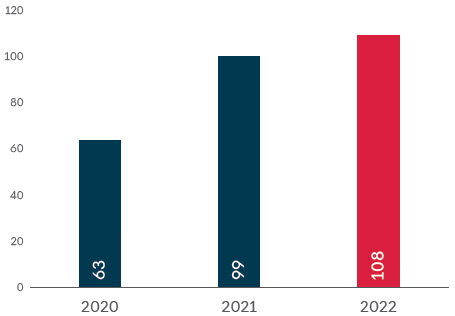
Training hours per employee (South Africa)
Letter from the Chairman of the Social, Ethics and Sustainability Committee


The SES Committee is proud to present to stakeholders Motus' second ESG report, in which the Group provides insight into how it leads with purpose, leveraging mobility for good to strengthen our stakeholder relationships and make a positive difference in the lives of our customers, employees and society.
The Group's sustainability and resilience reflect our ability to embed our values in delivering on our strategy and ESG objectives. Motus deserves recognition for sustainably growing its business, providing opportunities for jobseekers and suppliers and positively contributing to community upliftment. It has not achieved this because circumstances have favoured it; instead, the perseverance and agility of our leadership, workforce and business model have stood us in good stead, delivering success despite stiff economic headwinds in our markets of operation. This success has been achieved without compromising our commitment to sustainable practices and by continually enhancing the Group's ESG reputation.
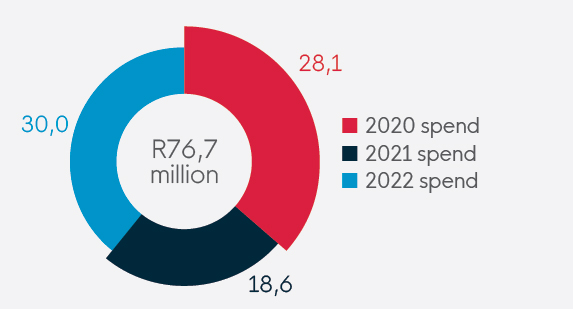
Some notable highlights from the year in review include the setting of new environmental targets for the next three years, steps taken to develop a holistic waste strategy, good improvement of black representation at management level, the implementation of a diversity, equity and inclusion (DEI) plan, numerous initiatives to enhance engagement with our employees, and a 60% increase in our CSI spend to help our social partners sustain and expand their critical work in communities. In June 2022, our efforts were acknowledged when Motus secured its second sustainability-metrics linked funding of R6,8 billion, a first for the automotive sector in South Africa.
South Africa's Companies Act stipulates that social and ethics committees are responsible for monitoring how companies contribute to socio-economic development, corporate citizenship, environmental protection, health and public safety, consumer relationships and employment. You will find ample detail in this report on these issues.
Regulation also commits us to a 'Corporate Compliance Programme' as per a practice note from the Companies and Intellectual Property Commission. Our approach to these issues, which includes combating fraud and corruption, is covered in the ethical and compliant business conduct report.
The breadth of this mandate means that the SES Committee is not only responsible for monitoring compliance, but also for encouraging the organisation to further embed an ESG mindset and supporting action plans.
During the year, external experts addressed the executive team and the board on the Group's current progress and provided recommendations on how to better integrate ESG considerations into the Group's strategies and operations. I trust you will read beyond the numbers and appreciate how our managers and executives – as leaders of mobility – are embracing ESG and making provision for the resources needed to integrate ESG in their daily operations.
Enterprise supplier development spend over three years (Rm) (South Africa)
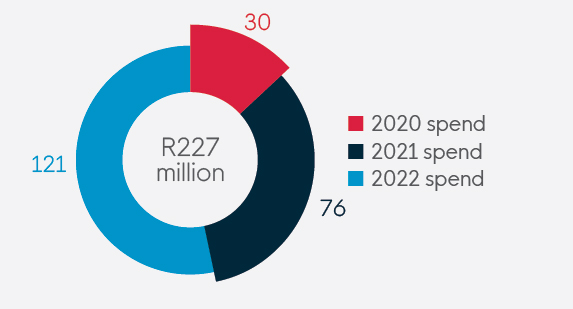
Corporate social investment spend over three years (Rm) (Group)
Exits by employee category
YES4Youth Programme
Motus does not apply a one size fits all approach. This has enabled the Group to align the key ESG concerns of the developed economies in which we operate, which focus on environmental improvement, with the socio-economic challenges in our home market, all the while underpinning our environmental and social initiatives with clear governance models and frameworks.
In the short to medium term, internal combustion engines will remain central to transport and logistics systems. While we welcome the global shift toward cleaner modes of travel, the pace of transition is uneven across the three jurisdictions in which we operate; unsurprising given the differing operating environments between South Africa, the UK and Australia, particularly in terms of the infrastructure needed to support low-emission vehicles. In addition, affordability is the key barrier to adoption in South Africa.
Our industry, which is a fairly high contributor to carbon emissions, is changing. When circumstances permit, we stand ready to support South Africa's transition and customer preference for new energy vehicles. Until then, we have defined the factors within our control that we can leverage to lessen the direct environmental impact of our operations. As discussed in our environment report, we achieved a 4,9% reduction in carbon emissions against a year-on-year revenue increase of 5,5%, with additional renewable energy systems expected to come online in the next two years. Our past investments in environmental improvement projects have provided us with a good understanding from which we can start to ready the Group for a net zero carbon emissions plan.
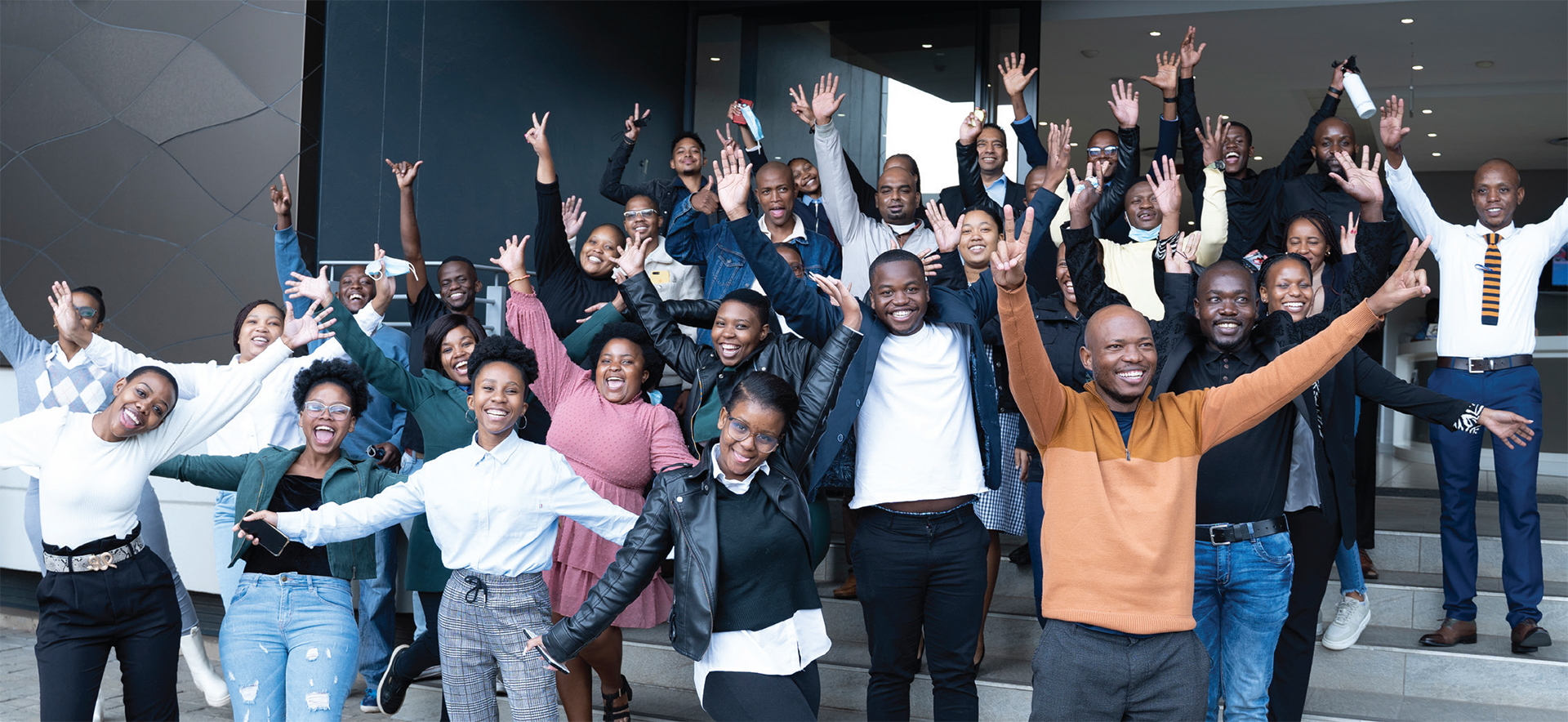
Creating and sustaining job opportunities for the youth and offering them a dignified career path of self-reliance and self-improvement, is urgent for South Africa and a top priority for Motus in our human and social capital efforts. The YES4Youth Programme is an excellent example of public and private sectors aligning to give more young South Africans work experience. We are proud to be part of this programme and to be in a position to offer full-time positions to 48% of the YES learners who have spent the past year as part of the Motus family. This programme builds on our commitment to the Imperial and Motus Community Trust, which employs and trains unemployed youth as library assistants. Today, 63 libraries and resource centres support the education and aid the literacy of over 72 000 learners in under-served schools in Gauteng.
During the year, the Group launched the 'EmpowerHer Affinity' Group to encourage women's networking and assist our female leaders on their journeys to success and empowerment. In support of our DEI plan, from 2023 female representation and the representation of people living with disabilities will be included in the performance criteria of business segment CEOs. Beyond our workplace, we support the growing network of black female professional nurses who provide primary healthcare through the 124 Unjani Clinics facilities, which during 2022 served 864 122 patients. Testament to our DEI efforts is our inclusion in the Satrix Inclusion and Diversity Exchange Traded Fund, the first of its kind in South Africa.
While our rate of road accidents and incidents has decreased despite more road activity as business normalises, it is with sadness that we reported two employee road fatalities and five third-party road fatalities for the year. We also mourned 25 of our colleagues who succumbed to the COVID-19 virus. We offer our deepest condolences to the families, friends and co-workers of those who lost their lives.
The Group's efforts to communicate the importance of COVID-19 vaccination has paid off; over 75% of our employees have been vaccinated. As the severity of the COVID-19 virus lessens, the trauma and toll of the past two years is likely to remain vivid; as well as the economic and social costs. The need for our employee assistance programmes will remain critical to support the wellbeing of our employees and their families. How we take care of our people and promote life-affirming values is explained in the health, safety and wellbeing report.
Unfortunately, in socio-economic terms South Africa remains a country of insiders and outsiders; with the latter threatened by poverty and hunger. In our transformation and community reports on pages 94 and 108 respectively, you will read about how we are working with non-governmental organisations (NGOs) to relieve the suffering of the most vulnerable in our society, stepping up in times of crisis. This year we donated R6 million to Gift of the Givers to support riot and flood victims in KwaZulu-Natal. Beyond South Africa, our employees in the UK provided support to victims of the Ukraine war, collecting supplies and donations.
While South Africa's socio-political realities remain a concern, I am comfortable with the relationships that Motus has cultivated with its stakeholders, including government, and we will continue to promote public-private partnerships (like the YES4Youth Programme and other transformative initiatives being undertaken by our industry bodies) where our aims and values align.
Since 2018, we have linked executive remuneration incentives with appropriate ESG outcomes, for example, environmental improvement projects, employment equity and regulatory compliance (explained in board oversight). The committee is pleased with the progress in these initiatives for the year under review.
Motus' long-standing commitment to sustainable practices enables it to appropriately manage the current uncertainty in our operating environment, including the ESG‑related risks and opportunities. The depth of experience, commitment and agility of Motus' leadership provide comfort to the SES Committee that the Group remains well-positioned to not just navigate through the foreseeable future, but to thrive.
I thank my fellow committee members, as well as management, staff and the board, for their support and responsiveness in helping the SES Committee fulfil its mandate; and in demonstrating clearly and measurably that financial performance and sustainability at Motus are entirely reconcilable – even in incredibly tough times.
Johnson (JJ) Njeke
Chairman of the SES Committee