


Reducing our carbon footprint
An energy-efficient building is generally a better environment in which to work and is significantly less expensive to run. We are analysing where solar PV installations are feasible within our site network so that we can reduce costs, contribute towards taking electricity demand off the national grid and assist South Africa to meet its international obligations to combat climate change.
Our reliance on the public utility for electricity exposes our operations to load shedding and power failures, which necessitates the use of petrol or diesel generators. Our operations have adequate access to generator power supply. While we do not view this as a sustainable solution, investing in alternative greener sources of power (a solar PV system costs on average between R850 000 up to R1 million to install) is not viable across the entire network of our operations.
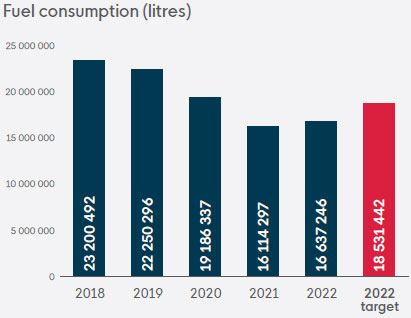
Electricity is becoming a larger part of our cost base. Our biggest consumers of fuel are our generators, company vehicles, test drives of vehicles to generate sales and the Car Rental fleet. To a lesser extent, fuel is used to deliver aftermarket parts to customers, although a dedicated team works to achieve route optimisation. Route optimisation is also part of our logistics planning when moving vehicles between locations.

- The need to use generators to ensure business continuity comes at a higher cost (fuel and maintenance costs).
- Limited ability to build a fleet of vehicles or sell vehicles with the most modern engines and lowest possible emissions given the quality of fuel supported in South Africa (inferior grade to that sold in first world markets).
- Lack of transmission lines required to feed excess renewable power into the grid and offset the cost of solar PV systems.
What we are doing
Energy-efficient technologies
Over the past couple of years, we have been installing energy-efficient lighting and air-conditioning systems and replacing energy intensive lights with light emitting diodes (LEDs). In South Africa, around 80% of our sites have implemented energy saving lightbulb replacement programmes. In certain operations, we are implementing natural light harvesting projects where sensors adjust the brightness of lights based on the amount of sunlight entering an area. This solution works particularly well in our showrooms. Light sensors that switch lights off in unoccupied areas, and timers on air-conditioning and heating systems also contribute to more efficient use of electricity. Old electronic equipment is replaced with energy-efficient alternatives when retrofitting projects are undertaken or equipment becomes redundant.
Electricity meters
In South Africa, electricity meters are used at many sites to monitor consumption, identify spikes and energy-saving opportunities, and compare actual consumption to municipal charges.
Solar PV systems
Our key focus is to understand where it makes commercial sense to install solar PV systems across our building footprint with a number of feasibility studies currently underway.
Fuel-efficient vehicles
Incorporated in our buying plans, our fuel strategy is to procure lower emissions vehicles for our fleets, including the Car Rental fleet and our company vehicle fleet.
2022 performance and key objectives
Group
- To reduce our carbon footprint, we set a new internal stretch target to decrease electricity consumption by 11% and limit our use of vehicle fuel to a 6% increase over three years to 2024.
- Electricity consumption was 0,6% above target. At Group level usage decreased 4,4% compared to 2021 with South Africa consuming 5,9% less electricity. Despite an increasing footprint in 2022, the solar PV projects implemented over the past two years have resulted in a continued decrease in our purchased electricity consumption.
- Road fuel consumption was 10,2% below target, and 3,2% higher across the Group compared to 2021. Road fuel consumption in South Africa increased 6,9% compared to last year. These increases are mostly due to increased trading activity following the impact of COVID-19 and employees with company vehicles returning to the office environment.
- The 4,9% reduction in carbon emission is pleasing against a year-on-year revenue increase of 5,5%. The marginal increase in Scope 1 emissions was due to increased road fuel usage and the increase in Scope 3 emissions due to increased business travel as activities resumed following the lifting of COVID-19 restrictions.
Energy consumption

Gas (mostly the UK)
18 493 480 kWh
natural gas
(2021: 22 815 756 kWh)
Note: kilowatt hour (kWh).
Carbon footprint
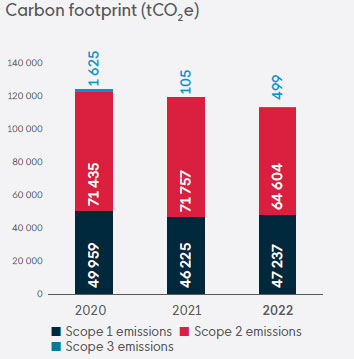
Note: tonnes of CO2 equivalent (tCO2e)
Note: 2020 and 2021 restated due to a change in carbon emission factors applied to better reflect the South African environment.
Carbon intensity ratio
1,2 tCO2e/Rbn
(2021: 1,4 tCO2e/Rbn)
Carbon tax paid
R179 000
paid in carbon emissions tax on 256 656 litres of stationary combustion fuel
(2021: R95 446 on 132 755 litres of fuel)
South Africa
- We are on track to submit our EPCs to the South African National Energy Development Institute1 in December 2022. An EPC rates buildings on the amount of energy consumed per square metre, and in the private sector, applies to non-residential buildings with a net floorspace of at least 2 000 square metres. Certificates, which are valid for five years, are to be issued by an accredited inspection body, and prominently displayed in the foyer of a building.
- Our new multi-franchise dealership in Menlyn (Pretoria), uses LED technology, with an estimated payback period of between three and three and a half years. Light sensors in the showrooms dim the lighting depending on the amount of daylight available, avoiding unnecessary electricity usage. Occupancy sensors shut down air-conditioning units in empty showrooms and other facilities. The grid-tied solar PV system is approximately 150 kilovolt-ampere, which can be extended in the future. The general payback period is three years. The PV system is also tied into the generator, saving fuel when the generator is in use. Energy-efficient water heating pumps and air-conditioning systems have also been installed.
- Over 35 dealerships in Import and Distribution have been identified for solar PV installations in the next two years.
- Hyundai operates solar PV systems at 15 of its key sites, including its PDC. Five additional dealerships have been identified for potential solar installations by the end of calendar year 2022.
- 23 Kia sites are being evaluated for a solar PV system or a renewable energy pay-as-you-use purchase agreement, which may be a more feasible option to the capital expenditure associated with solar installations.
- The cost of Renault's 80 kilowatt solar plant installed at its PDC last year is expected to be recouped within seven years, providing a 91 256 kWh saving excluding weekends.
- Retail and Rental operates solar PV systems at 12 of its key sites and following feasibility studies has approved solar PV systems for a further 10 new sites.
- Mobility Solutions installed a small scale solar PV system at its campus in Johannesburg, aiming to reduce the campus' electricity bill by 20%. To date, the system has generated 5 307 kWh of energy, achieving an energy saving of 0,5%. The business segment is exploring options to upgrade the PV system to reduce the impact of prolonged power outages.
- Some progress was made in 2022 to purchase lower-emissions vehicles for the Car Rental fleet; however, global supply constraints limited our purchases and the strategy had minimal impact on our Scope 1 emissions. Pleasingly, regulations were published in 2022 on petroleum products specifications and standards in South Africa to introduce fuels with a sulphur content of less than 10 parts per million by September 2023. This will enable our fuel strategy to procure lower emissions vehicles for our fleets. Kia is already changing the profile of its demo vehicles to lower emissions emitting models.
1 The South African National Energy Development Institute maintains an EPC register on behalf of the Department of Mineral Resources and Energy.
Regions
- We have identified some good opportunities to potentially roll out solar PV solutions at some of our larger dealerships in the UK.
- A solar solution is being implemented at our multi-franchise dealership in Traralgon, Australia.
Objectives
- Group: as we mature our energy-efficiency and renewable energy projects we will start to ready the Group for a net zero carbon emissions plan and develop carbon emissions targets for the South African operation. In our regional operations we will align to national targets and OEM product guidelines.
- Group: seek validation of our targets by the Science Based Targets initiative (SBTi) within the next two years.
- South Africa: install a solar PV system in the shared PDC for Kia and Mitsubishi in 2023. We have set an objective to install solar PV systems at all Importer PDCs by early 2024. The business segment is also assessing the viability of selling renewable energy into the power grid from our bond stores.
- South Africa: roll out LED conversion projects at five business sites in 2023.
- South Africa: continue to introduce energy-efficient or less carbon intensive vehicles in our vehicle fleet.
- UK and Australia: expand the number of charging points in dealerships as the number of plug-in EV sales increase.


The Menlyn multi-franchise dealership boasts seven showrooms, with multiple initiatives implemented to ensure the facility operates efficiently in terms of energy use. Plastic, paper, metal and glass are separated at source and recycled.