


Transforming our workforce
Our long-term objective is to have a local workforce that is reflective of South Africa's economically active population (EAP)1 by 2028. Our key focus is to increase the number of black people and black women in management positions and continue to develop the skills of our black employees.
- Transforming our senior and middle management levels in a subdued growth environment, which limits our ability to hire new employees and few management positions become available due to low employee turnover at these levels.
- Failure to meet the Department of Employment and Labour's (DoEL) proposed sector targets could result in a penalty should the reasons for underachievement not be deemed acceptable.
What we are doing
Employment Equity Plan
Our Employment Equity Plan sets out co-ordinated and targeted interventions to recruit, develop and promote candidates to achieve our race, gender and disability targets. Our talent pipeline programmes provide a pool of entry-level candidates from designated groups from which we can fill vacant posts. These candidates are upskilled through our accredited technical training programmes and formal learnerships. We ensure an appointment, promotion and training ratio of over 50% in favour of employees from designated groups.
 Leveraging a diverse and change resilient culture:.
Building our portfolio of future-ready skills:.
Our talent management framework:.
Stakeholder engagement
The Employment Equity Amendment Bill will drive sectoral targets for designated groups. As an employer organisation, the RMI interrogated the demographic data set provided by the DoEL against its own data, and following consultation with its members, submitted proposed targets for the Wholesale & Retail Trade of Motor Vehicles and Motor Cycles Sector in April 2021. The DoEL has since suggested its own targets which could be promulgated in 2023. Discussions are ongoing between the various stakeholders as well as among our management teams to ensure that we develop a responsible and sustainable plan towards meeting new prescribed targets. Through naamsa's transformation council we engage with the broader automotive value chain, including manufacturers and parts suppliers, on these targets to expedite change within the industry.
How we measure our performance
Our Employment Equity Plan to 2023, which covers employment equity, skills development and barriers to transformation based on a workplace analysis, is submitted to the DoEL. Targets, including interim targets, are set for race, gender and disability at each occupational level and for skills development for each business segment and consolidated at a Group level. Targets are submitted to the DoEL annually. Our employment equity metrics are independently verified as part of the B-BBEE scorecard verification.
Our key targets for June 2023 are:
- Senior and middle management: reflective of 50% EAP of African people. This equates to 21% of senior and middle management comprising African men and 18% being African women.
- Junior management: reflective of 60% EAP of African people. This equates to 26% of junior management comprising African men and 22% being African women.
1 EAP includes people from 15 to 64 years of age who are either employed or unemployed and seeking employment.
2022 performance and key objectives
South Africa
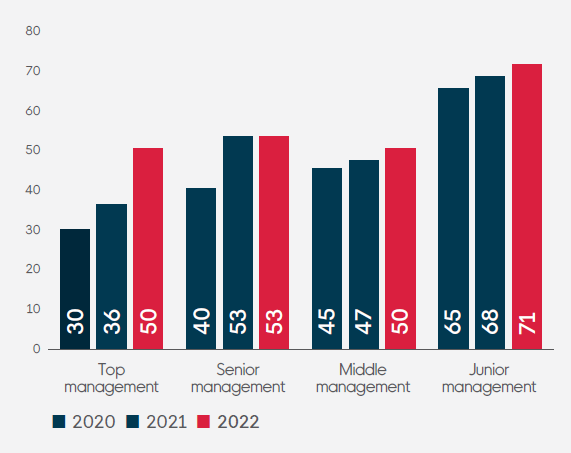
- The competitive labour market and economic conditions that were more challenging than we expected impacted our ability to employ the number of people needed to meet our original 2022 employment equity targets. Revised targets were submitted to DoEL and we made good progress in meeting most of these targets. We appointed a new black Executive Committee member and the targets for black representation at top (target: 45%) and junior (target: 68%) management and the semi-skilled employment level were met. At senior (target: 55%) and middle (target: 51%) management we marginally missed target by 2% and 1% respectively. Through our new approach to DEI we aim to find practical solutions to further improve our employment equity. That said, when comparing black representation to 2017 there has been a considerable improvement with top management moving from 17% to 50%, senior management from 24% to 53%, middle management from 36% to 50%, and junior management from 56% to 71%.
- A number of learnerships were supported during the year, key among these being over 400 learners on the Youth Employment Service (YES4Youth) Programme and a learnership for 50 learners living with disabilities funded by head office. We leveraged the YES4Youth Programme to employ 196 young people, particularly within sales.
- Mobility Solutions, working with the Ann Harding Cheshire Home, permanently employs three people living with disabilities who work remotely from a facility for the disabled in Randburg, Johannesburg. The business segment is investigating if there are opportunities to expand the concept into other areas of its business.

Black representation at management level (%)
Black dealer principals
Composition of the overall workforce
Hires and promotions
Exits
Skills development
was used to develop black people (2021: 72%)
was used to develop black women (2021: 14%)
are black
Objectives
- Develop a new five-year employment equity plan once the proposed sector targets have been promulgated.
- Continue to support the YES4Youth Programme, giving young people relevant work experience, preparing them for future employment. We will also assist those who need to obtain a driver's licence as part of the programme. Our target intake for the second cohort of the programme is around 420 learners.
- Focus on improving the representation of women and people living with disabilities.
Case study
YES4Youth is an initiative launched by President Cyril Ramaphosa in 2018 to encourage government and the private sector to work together to create critical work experience opportunities for young people between the ages of 18 and 29. At June 2022, the initiative had created over 81 400 work experiences and injected over R4,5 billion into the economy through salaries1.
YES4Youth
Programme
Our partnership with YES4Youth started in February 2021, with the first cohort of over 400 unemployed job seekers finishing their learnerships in June 2022.
- The learners received a one-year fixed term contract, a mobile device for ongoing support and training, access to learning opportunities to support their career growth and assistance with obtaining driving lessons and driving licences.
- Interns were placed in various roles across ourfour business segments (340),at headoffice (12)and with our CSI programme partners – the Imperial and Motus Community Trust (13) and the Unjani Clinics network (50).
- The roles were specifically created for our YES4Youth Programme, enabling participants to gain valuable experience in a number of fields, including sales,technical, warranty,parts,retail operations, marketing and communication, finance, warehousing, after-sales logistics administration and customer care.

#YES4Youth
To date, our
investment in the
YES4Youth
Programme is
R18,7 million.
From the first cohort,
196 (48% ) YES
learners have been
employed at Motus.

1 https://yes4youth.co.za/ (8 June 2022).