Our talent management framework
A healthy talent pipeline supports robust succession planning, and facilitates the internal career growth of talented individuals who can contribute towards our strategic objectives. Talent management is about balancing new entrants and skill into the workforce while retaining experience and institutional knowledge.
Our key
focus
areas
- Conduct internal and external talent mapping.
- Recruit for new skills and mindsets and explore alternative (non-traditional) employment models.
- Develop talent pools based on potential.
- Facilitate talent mobility and foster key talent for critical roles to ensure readiness.
- Succession management.
- Fierce competition for top talent made more difficult in South Africa due to the emigration of skilled labour resources to better economic growth environments.
- The age profile of the succession pipeline is the same as incumbent leaders, potentially constraining the ability to improve the age diversity of the leadership profile.
What we are doing
Succession planning
Our succession plan is dynamic, and reviewed regularly at Group, business segment and regional level. Detailed succession plans are in place for top, senior and middle management roles. Succession plans for executives are submitted to the Nomination Committee for review and discussion.
Talent management framework
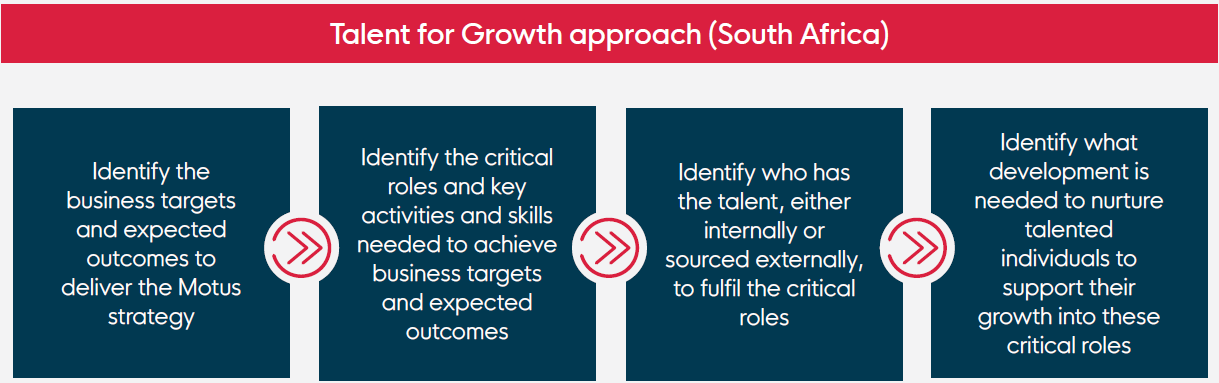
Our talent mapping approach is designed to drive incremental business growth and support a more flexible approach to skills and workforce planning as new ways of working increase, while highlighting and fostering the development of key talent. Potential successors for critical roles are identified in our performance management process. This process also helps us ensure that our development programmes are fit-for-purpose and provides employees with the opportunity to voice and advance their career growth aspirations.
Internal mobility
The proactive and strategic movement of employees with the appropriate skills across different roles, projects and geographies in the Group, enables them to gain experience, provides the Group with a pool of candidates for promotion when opportunities arise and unlocks organisational value by placing talent where it can make the most impact. In addition, secondments are an attractive EVP, particularly for individuals with sought after skills.
Leadership development
Our leaders play a critical role in effectively empowering employees and motivating high-performance teams. Our wide range of training, mentoring and networking opportunities provide a constant supply of increasingly experienced and capable leaders at all levels stemming from within the Group. Our programmes are designed to equip our leaders and potential leaders to exhibit the key behavioural and critical success factors needed to navigate successive levels of leadership right up to the Group CEO position. Our investment in our leaders is an investment in Motus' future and creates a ripple effect that positively impacts the Group's culture.
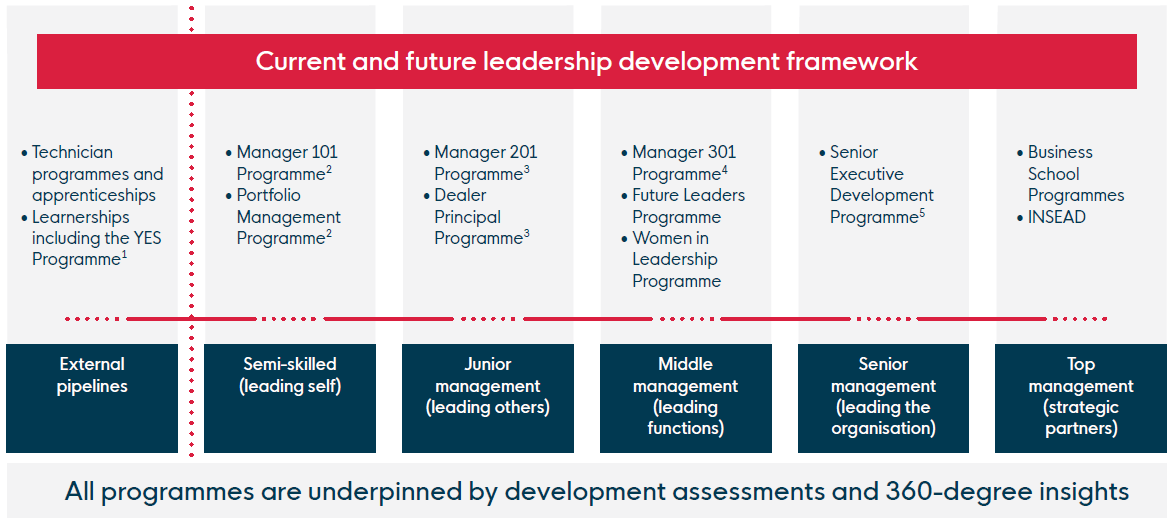
In addition to the above, our recognised three-year Bachelor of Business Administration (BBA) degree, in partnership with the Southern Business School, is tailored to the Group's needs. The 17-module programme develops employees who are or will be responsible for resources and projects and managing people. Participants are able to further their studies with a postgraduate degree. To date, 347 employees have graduated with BBA degrees. Participant feedback notes the life-changing nature of earning a degree, as well as how it improved their decision-making skills, enabled a better understanding of market forces, and developed the skills needed to make sense of complex business data, improve efficiency and gain a new perspective on Motus.
The three-month Future Leaders Programme6 equips leaders in South Africa with the skills to think at a higher strategic level and to effectively respond to change. The programme is aimed at middle and senior management, enabling participants to improve the efficiency, effectiveness and legitimacy of their leadership.
The Dealer Principal (NQF57) and Portfolio Manager (NQF4) programmes are customised for Motus and are merSETA8 quality assured national certificates.
The nomination process for our leadership development programmes starts with information gathering followed by nominations. Potential delegates are then assessed and interviewed, and a final list of delegates approved by CEOs and department heads.
In the UK, our well-established Management Development Programme targets future leaders in middle and senior management identified as having high potential in the succession planning process. The five-module course focuses on self-awareness, people management, finance skills and customer handling.
| 1 | The national Youth Employment Service  (YES4Youth) Programme. (YES4Youth) Programme. |
| 2 | Manager 101 targets new leaders and sales personnel and the Portfolio Management Programme develops the skills of sales, parts and workshop managers (five and 12-month programmes respectively). |
| 3 | Manager 201 targets leaders who manage teams and the Dealer Principal Programme develops the skills of current and potential dealership principals (five and 12-month programmes respectively). |
| 4 | Advances an individual's skills to manage long-term strategy and gain a competitive advantage in their operations (eight-month programme). The content of the programme aligns with our Design Thinking and Innovation model. |
| 5 | Currently being designed. |
| 6 | Formally the Executive Leadership Programme. |
| 7 | South Africa's National Qualifications Framework (NQF) level 5. |
| 8 | merSETA: Manufacturing, Engineering and Related Services Sector Education and Training Authority. |
How we measure our performance
The quality and depth of our succession plans are the ultimate measure of the effectiveness of our Talent for Growth framework.
2022 performance and key objectives
Group
- We conductedan in-depth analysis of succession coverage at senior and middle managementlevels. Good progress was made in updating the Group executive succession plan and plans are in place to address identified risks in employment bands beneath executive level.
- Cross-functional and business segment talent exchanges were facilitated to support successor visibility and mobility. Financial directors are regularly moved between business segments and franchises to gain depth of experience and exposure to the broader value chain.
South Africa
- We finalised the talent management playbook to guide businesses on how to effectively apply the Talent for Growth approach. The playbook covers talent attraction and retention, talent spotting for critical roles, talent development and succession.
- The BBA distance learning video model was enhanced and incorporated monthly video support for delegates. At the end of the 2021 calendar year, an average pass rate of 91% was achieved across all classes. 43 delegates graduated, and 39 first year and 28 second year students will progress. The BBA Programme was transitioned to a virtual learning model, ensuring that employees across South Africa have equal opportunity to enroll regardless of location.
Leadership development
Programme, 81% are black and 43% are
women (2021: 12)
Programme, 64% are black and 54% are
women (2021: 12)
Programme, 79% are black and 43% are
women (2021: 11)
66% are black and 37% are women
Programme, 71% are black and 17% are women (2021: 16)
Programme, 59% are black and 27% are women (2021: 7)
Programme, 55% are black and 40%
are women (2021: 15)
Regions
- In the UK, 19 delegates are participating in the Management Development Programme (2021: 15).
Objectives
- Group: expand the focus of succession plans to include future critical roles.
- Group: continue to identify the skills needed to deliver our strategic priorities and fill gaps, and identify where our successors may have skills gaps and provide them with the development they require to be future fit.
- South Africa: establish a quarterly Leadership Forum to advance the Motus strategy. Attendees will include the top two layers of leaders and selected high-potential individuals. The forum will:
- Increase employee exposure to executives
- Provide a platform for the leadership team to announce key business initiatives and drive clarity around the Motus strategy.
- Support a strong sense of leadership and community culture.
- South Africa: encourage managers to openly discuss employee career aspirations and identify attrition risks.
- South Africa: assess the external labour market for talent availability, for example, reinstitute the university programme to recruit for the talent pipeline.
- South Africa: invest in a digital system to manage and monitor key talent.